“Strong growth and inflation; tightening to continue” ... Further rate hikes projected for November and early next year [Base rate held at 3.0%]
- Input
- 2026-10-22 18:38:05
- Updated
- 2026-10-22 18:38:05
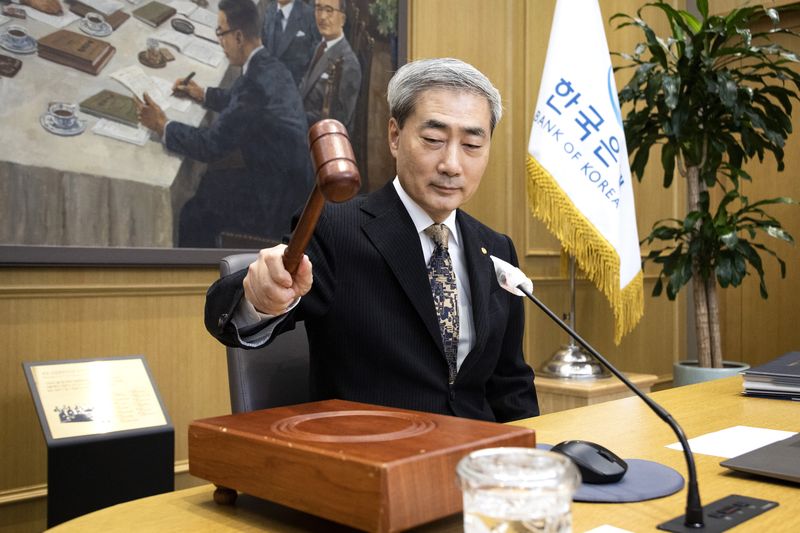
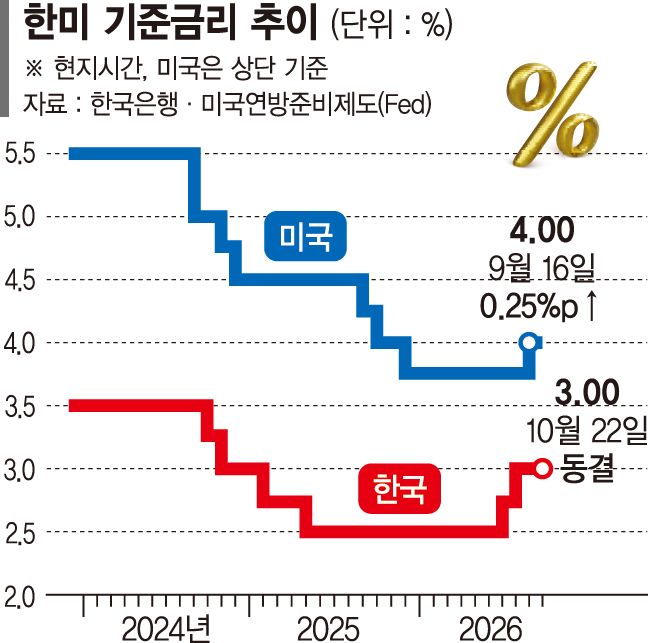
The BOK said that it had decided to keep the rate unchanged at a meeting that day to determine the direction of monetary policy, with all seven Monetary Policy Board members voting unanimously. The BOK had previously raised the benchmark rate by 0.25 percentage points in both July and August, bringing it to 3.00%.
At a press conference after the Board meeting that day, BOK Governor Hyun Song Shin explained the decision to hold rates: “Rather than making a move this time, we need to assess the effects of the preemptive rate hikes on growth, inflation trends and financial stability. I thought it would not be too late to examine the situation further using incoming data, including third-quarter gross domestic product (GDP) and October inflation trends.”
However, Governor Shin left the door wide open to further rate hikes. He said, “We will continue our tightening stance until consumer prices converge to the stable level of 2%.” He expected inflation to settle in the stable range of around 2% in 2028, making clear his commitment to continued additional tightening until then.
The rationale for holding rates this time was to assess the effects of tightening and adjust its pace. Behind the decision were stronger-than-expected growth and rising inflationary pressures.
The domestic economy is expected to see customs-clearance exports, led by semiconductors, exceed $1 trillion this year, while the current account surplus is projected to surpass the $450 billion forecast made in August. Accordingly, economic growth this year and next is also expected to significantly exceed the August forecasts of 3.3% and 2.9%, respectively.
Inflation, too, is expected to remain high for a considerable period. This year’s consumer price and core inflation rates are expected to be close to the August forecasts of 2.7% and 2.5%, respectively, but next year they are expected to substantially exceed the previous forecasts of 2.3% and 2.5%.
Assessing the outlook for inflation, Governor Shin said, “Despite the decline in the exchange rate, the pass-through of higher cost pressures resulting from the rebound in oil prices and rising semiconductor prices will continue. Demand-side pressures will also grow, and inflation will remain above the target for a considerable time.”
Governor Shin also offered candid remarks indicating some agreement with the view that the government’s expansionary fiscal policy and monetary tightening are working at cross purposes. “The government’s expansionary fiscal policy can boost aggregate demand in the short term and add to inflationary pressures,” he said. “If it leads to ongoing fiscal spending items (programs), they will be difficult to reverse (when fiscal policy is tightened), which is a concern from the perspective of fiscal sustainability.”
Citing the BOK’s analysis that next year’s government budget proposal, worth a record 821 trillion won, would raise GDP growth by 0.5 percentage points and inflation by 0.06 percentage points, Governor Shin said that government transfer spending (such as various subsidies) has a fiscal multiplier of around 0.2 (a low figure). He indirectly criticized, in particular, populist spending programs, saying they have little effect on boosting growth by translating into investment and consumption.
Governor Shin also criticized the government’s price cap on petroleum products, which it uses as a powerful tool to curb inflation. “The longer it remains in place, the more it distorts the price structure, and it does not even restrain consumption,” he said. “In the long term, it will create considerable problems for government finances.”
Turning to exchange rates, which are directly linked to inflation, Governor Shin said, “The recent downward stabilization of the won-dollar exchange rate is part of a reversal of abnormal conditions, and volatility has fallen sharply.” He added, “The won remains considerably undervalued compared with its average in previous years, and is still weak according to the Bank for International Settlements (BIS) effective exchange rate, which takes trading partners’ weights into account.”
These hawkish remarks by Governor Shin suggest that the tightening stance will grow stronger over time.
The Monetary Policy Board plans to weigh the timing of further benchmark rate hikes after assessing inflation, economic conditions and financial stability. On future monetary policy, Governor Shin stressed, “As the growth rate rises, the equilibrium interest rate also rises. We will closely monitor inflation and economic trends, as well as financial stability, as we determine the timing and pace of any further rate hikes.”
The Monetary Policy Board’s final monetary policy decision meeting of the year will be held in November. The U.S. Federal Reserve’s Federal Open Market Committee (FOMC) meeting, scheduled for the 27th and 28th, is expected to be a key indicator of whether further tightening will be decided.
[email protected] Jung Sang-gyun Reporter