AI Assesses Claims, People Take Responsibility... Insurance Industry Workforce Landscape Shifts [The AI Agent Era Comes to Insurance, Too]
- Input
- 2026-10-22 18:33:45
- Updated
- 2026-10-22 18:33:45
■ People make the final decision, even when AI makes assessments
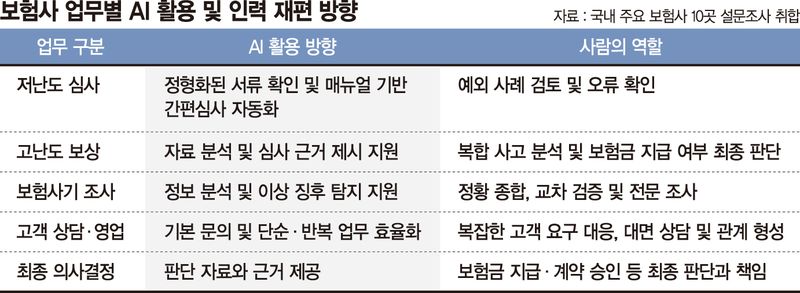
According to a survey of 10 major domestic insurers conducted by Financial News on the 22nd, insurers stressed the “human-in-the-loop” principle: AI supports decision-making, but people make the final decision. Even when AI analyzes information and provides grounds for an assessment, matters affecting customers’ rights and obligations, such as insurance claim payments or contract approvals, must be reviewed and approved by the responsible employee.
Claims assessment is an area where both the benefits and limitations of AI automation are apparent. Checking standardized documents or assessing claims according to a manual can be readily automated, but expertise and experience are needed to make an overall assessment of complex medical records, the circumstances of an accident, and the possibility of insurance fraud. That is because an AI error could lead to an unjustified denial of an insurance claim or a delay in payment.
Systems for explaining the grounds for decisions and verifying errors are also important. If an unfavorable decision is made for a customer, the information used and the criteria applied must be explainable, and there must also be a process for a person to review the case when an objection is raised.
Insurers say they need to establish internal controls, including monitoring declines in AI performance and bias and assigning a person responsible for each model. Ensuring reliable decisions and protecting consumers has become just as important as expanding the scope of automation.
An official at Insurer A stressed, “Even when AI is used, executives and employees must be responsible for final decisions affecting customers and for the accountability that comes with them,” adding, “The introduction of AI must not make it unclear where responsibility lies or weaken the company’s accountability.” Insurer B also said, “AI should play a supporting role, while people must make the final decisions and bear responsibility,” and added, “Explainable AI that presents the main grounds for AI decisions in a way people can understand is essential to consumer protection.”
■ AI could take over simplified underwriting and similar tasks starting in 2027
The introduction of AI is also expected to change how insurers manage their workforce. The direction is to leave simple document checks and standardized assessments to AI, while employees focus on work requiring expertise, such as complex claims decisions, handling exceptions, and responding to insurance fraud. The industry is placing more emphasis on reshaping jobs and roles than on large-scale workforce reductions.
One non-life insurer predicted that simplified assessments conducted according to a manual and the processing of small insurance claims could be taken over by AI around 2027–2028. Another outlook was that AI use in work requiring specialized assessment knowledge and expertise could be expanded in stages around 2029–2030, after the relevant criteria and experience have been systematized. This means the pace and scope of automation may vary depending on the complexity of the work.
As low-complexity assessment work declines, employees are likely to take on more complex tasks, such as analyzing multiple causes of an accident or deciding whether exceptional circumstances warrant payment. Human experience and expertise are especially important in insurance fraud investigations, which require cross-checking multiple sources of information.
It is also difficult to predict a uniform contraction in customer service and sales teams. Even if AI handles basic inquiries, people will still need to understand each customer’s circumstances and coordinate responses to complex requests. In fact, one non-life insurer predicted that its sales organization, which focuses on face-to-face consultations, could expand, unlike staffing efficiency measures for simple, repetitive work.
An insurance industry official said, “We expect structural changes rather than an overall reduction in workforce size,” adding, “Simple, repetitive jobs will be replaced by AI agents, and the workforce will shift toward roles that use specialized technology and create high added value.”
[email protected] Hong Yeji, Kim Tae-il Reporter