“Familiar with ChatGPT and Gemini” ... It comes down to awareness and confidence in quality [MOAI: Expectations and Reality]
- Input
- 2026-10-22 18:06:49
- Updated
- 2026-10-22 18:06:49
■ AI is widely used, but...
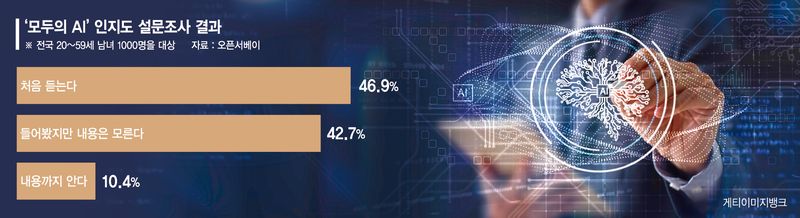
On the 22nd, a survey commissioned by Financial News from the research technology company OPENSURVEY INCORPORATED and conducted among 1,000 men and women aged 20–59 nationwide found that 46.9% had “never heard” of the government’s MOAI project. Another 42.7% had “heard of it but didn’t know much about it.” Together, the two responses accounted for 89.6%, meaning most respondents did not know the details of the project. Only 10.4% said they knew what it entailed.
Respondents had extensive experience using generative AI. A total of 87.7% had used generative AI in the past 3 months. Usage frequency was as follows: nearly every day, 35.1%; 3–5 times a week, 19.0%; and 1–2 times a week, 18.3%. Those who used it at least once a week accounted for 72.4%. Another 10.1% said they used it 1–3 times a month, while 5.2% had used it once or twice in the past 3 months. A further 3.8% said they had not used it in the past 3 months, and 8.5% had never used it. With so many people already using AI, MOAI needs to offer value that sets it apart from existing services.
■ Quality expectations are on par with ChatGPT and Gemini
Expectations for MOAI’s quality were cautious. The most common response, at 40.2%, was that it would be “about the same” as overseas generative AI services such as ChatGPT and Gemini. A total of 23.9% expected it to be “slightly worse,” while 13.5% thought it would be “much worse,” bringing the share expecting lower quality than overseas AI to 37.4%. By contrast, 10.1% expected it to be “slightly better” and 4.5% “much better,” for a total of 14.6% expecting it to outperform those services. Another 7.8% said it was “hard to compare” or that they “didn’t know.”
The survey results show that people do not expect superior quality simply because an AI service is developed domestically. This means the service must demonstrate accuracy and convenience that users can experience for themselves.
■ Winning over users familiar with AI
When the 877 respondents who had used AI in the past 3 months were asked to select all the services they had tried, 85.4% chose ChatGPT and 78.0% chose Gemini. Claude was used by 25.1%, Perplexity AI by 8.3%, and Microsoft Copilot by 8.1%. Among domestic services, 7.2% chose Kanana, 6.7% A., and 5.0% Wrtn.
Since most respondents had tried ChatGPT and Gemini, the answer quality of overseas services is expected to serve as a benchmark for evaluating MOAI. This has prompted calls for the project to present concrete use cases as it works to attract users. The explanation is that people will more easily understand how MOAI differs from existing AI if it clearly shows what domestic information users can access and how much help it can provide when using public services.
How the service is accessed is also expected to be key to raising awareness. Companies preparing the project plan to use familiar channels such as phone calls, text messages and ChatGPT for Kakao. The idea is to reduce the burden of installing a new app or learning how to use it, making the service accessible even to people who do not use AI often.
In response to an open-ended question about what they wanted from MOAI, respondents called for practicality, accurate answers and protection of personal information. Responses included: “I hope it will be genuinely helpful, rather than just existing in name”; “When I ask a question, I hope it will tell me only facts supported by evidence”; and “Sensitive personal information must be reliably protected.” The survey was conducted on September 30 among a nationwide panel of 1,000 people aged 20–59, using quota sampling proportional to the population composition. The margin of error was ±2.02 percentage points at an 80% confidence level.
[email protected] Yoon Hong-jip Reporter