Korea Aerospace University to Launch ‘Solar Sail Satellite’ Aboard Nuri (KSLV-II) in 2028
- Input
- 2026-10-22 18:07:01
- Updated
- 2026-10-22 18:07:01
[Financial News] Korea Aerospace University will develop a next-generation small satellite that navigates space using the pressure of sunlight without propellant and autonomously leaves orbit when its mission ends, and launch it aboard Nuri (KSLV-II) in October 2028.
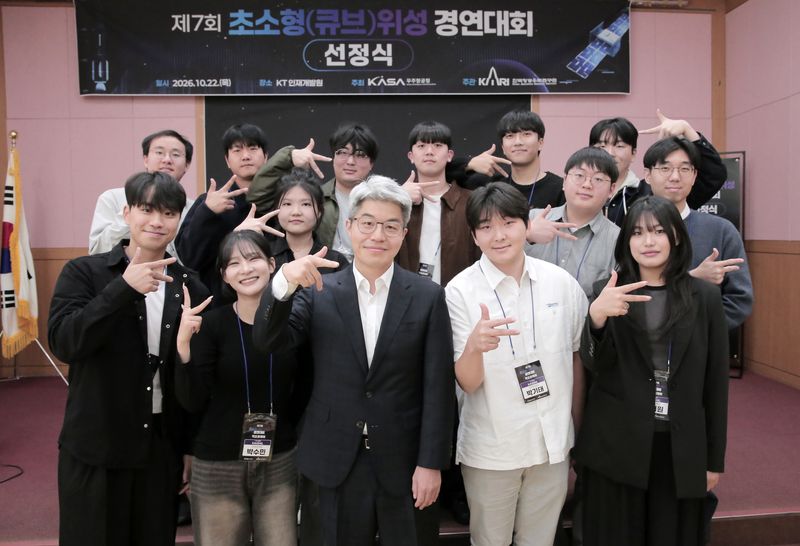
Korea Aerospace University said on the 22nd that a research team led by Professor Noh Jin-ho of its Space Engineering program (KAUSAIL) had been selected in the beginner category of the 7th CubeSat Competition, hosted by the Korea AeroSpace Administration and organized by the Korea Aerospace Research Institute (KARI), and had received its certificate of selection at a ceremony held on the 22nd at the KT Human Resources Development Center in Daejeon.
The selected satellite, KAUSAIL-D1, is a 3U CubeSat measuring approximately 30 centimeters. Once in orbit, it will deploy a large solar sail measuring 3 meters by 3 meters. Its primary mission is to demonstrate a next-generation space propulsion technology that uses the tiny pressure created when sunlight strikes an object’s surface to move through orbit without fuel.
In the later stages of its mission, the satellite will also use its deployed sail as a “drag sail” to increase atmospheric drag. By rapidly lowering the satellite’s altitude and deorbiting it, the mission will also test foundational technology for reducing the low-Earth-orbit space-debris problem, which has recently become a global concern.
With this selection, Korea Aerospace University will receive 700 million won in government research funding and build two satellites: a qualification model for testing and a flight model to be carried aboard the launch vehicle. The Korea AeroSpace Administration and KARI will provide development funding and technical support, as well as an opportunity to launch aboard the domestic launch vehicle Nuri (KSLV-II).
The project, which draws on the proprietary deployment-structure technology held by Professor Noh’s team, is expected to secure key data and technologies needed to reliably design and operate next-generation large-scale space structures, such as large solar panels and space data centers.
A total of 29 teams from across the country took part in this year’s CubeSat Competition. Seven university research teams were ultimately selected, including Korea Aerospace University, with five teams in the beginner category and two in the advanced category.
[email protected] Kim Man-gi Reporter