Samsung Electronics and SK Hynix hit by a barrage of sell orders; semiconductor rebound hinges on Big Tech earnings
- Input
- 2026-10-22 18:05:16
- Updated
- 2026-10-22 18:05:16
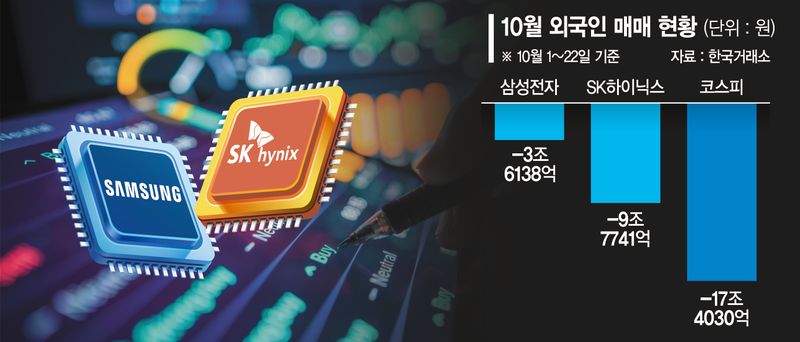
As the KOSPI alternates between sharp declines and rebounds, U.S. Big Tech companies’ third-quarter earnings and AI capital investment plans have emerged as factors that could determine the direction of domestic semiconductor stocks.
According to the Korea Exchange, foreign investors net sold 17.403 trillion won in the securities market from the 1st through the 22nd. Net sales totaled 3.6138 trillion won in Samsung Electronics and 9.7741 trillion won in SK Hynix, reaching 13.3879 trillion won for the two stocks alone. In effect, 76.9% of total net sales was concentrated in the two semiconductor heavyweights.
The KOSPI closed at 5,668.05 on the 16th, down 14.46% from a week earlier, then rebounded 3.29% to 5,735.66 on the 21st. But it plunged 3.52% again that day, ending trading at 5,533.77. As market volatility widens, with sharp declines and rebounds alternating, heavy foreign selling and the supply-demand pressure concentrated in large-cap semiconductor stocks are acting as major variables for the domestic stock market.
The key link between foreign selling and U.S. Big Tech earnings is the path from AI investment to demand for memory semiconductors. If major cloud companies such as Microsoft, Alphabet and Amazon expand investment in AI data centers, demand for high-bandwidth memory (HBM) and server DRAM could increase.
This affects memory prices and sales and earnings outlooks for Samsung Electronics and SK Hynix. Conversely, if Big Tech companies slow the pace of investment or AI businesses fall short of expectations in monetizing their services, expectations for future memory demand and earnings growth could also decline. That is why foreign investors watch U.S. Big Tech earnings and investment plans as indicators of future profits for domestic semiconductor companies.
Third-quarter results announced by Tesla and Meta on the 21st were mixed. Tesla reported revenue of $28.046 billion, down 0.2% from the same period a year earlier, and operating profit of $718 million, down 55.8%.
Meta reported revenue of $64.601 billion, up 26%, but operating profit fell 37% to $12.988 billion after $9.89 billion in settlement costs related to lawsuits over adolescent mental health were included. Excluding those costs, operating profit was up 11% from a year earlier to about $22.888 billion.
The Nasdaq index, too, has recently seen sharp declines and rebounds alternate, as market views on Big Tech earnings and the profitability of AI investment remain divided. Volatility is increasing as growth expectations clash with the cost burden of investment, and this trend is also weighing on domestic semiconductor stocks.
Big Tech earnings announcements continuing through the end of this month will be a key event for gauging the direction of AI investment. In Korea time, Alphabet and Microsoft are scheduled to report early on the 29th, and Amazon early on the 30th. Apple is expected to report earnings on November 3.
A securities industry official said, “Given that foreign selling in the domestic stock market is concentrated in large-cap semiconductor stocks, U.S. Big Tech earnings and AI capital investment plans will be important factors in restoring investor sentiment. If the trend of expanding investment continues and growth in cloud businesses provides support, expectations for memory demand at Samsung Electronics and SK Hynix could also be underpinned. But if doubts about returns on investment grow, share-price volatility could persist.”
[email protected] Kang Jung-mo Reporter