Hanyang University joins forces with Singapore’s SUTD on next-generation 6G and AI communications technology
- Input
- 2026-10-22 17:45:15
- Updated
- 2026-10-22 17:45:15
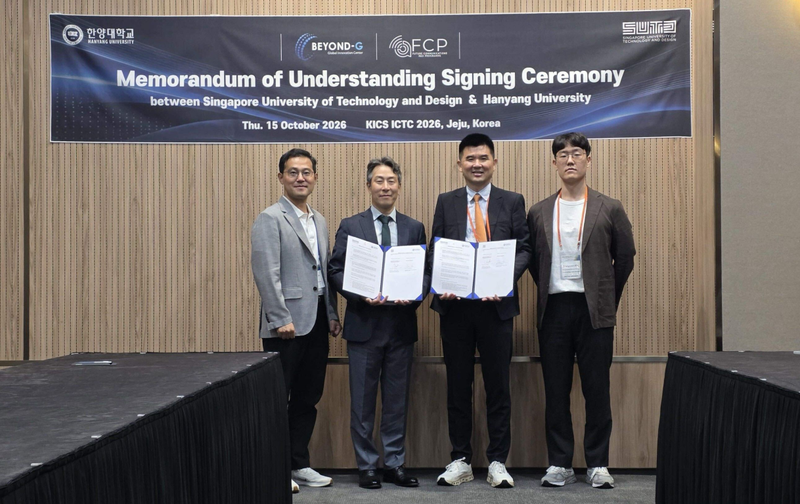
Hanyang University’s Beyond-G Global Innovation Center said on the 22nd that it had signed an MOU with the Future Communications Research and Development Program (FCP) at Singapore’s SUTD for international joint research into key next-generation communications and sensing technologies. The agreement was signed on the sidelines of the International Conference on ICT Convergence (ICTC 2026), held in Jeju on the 15th.
Under the agreement, the two institutions plan to collaborate in three key future technology areas: ‘integrated sensing and communications (ISAC),’ which uses communications signals to detect nearby objects and environmental conditions; ‘AI-RAN (Artificial Intelligence-powered Radio Access Network),’ which allows AI to independently manage and optimize network resources; and ‘low-Earth-orbit satellite positioning (LEO-PNT),’ which measures location and time with high precision and without coverage gaps.
The collaboration was launched to strengthen Hanyang University’s Beyond-G Global Innovation Center, which is supported by the Ministry of Science and ICT and the National Research Foundation of Korea (NRF), as a global research hub, and to combine its capabilities with those of Singapore’s SUTD, which has strengths in AI and communications, to deliver technology outcomes at a level ready for commercialization.
Sunwoo Kim, head of Hanyang University’s Beyond-G Global Innovation Center, said, “This agreement is highly significant because it establishes a foundation for international cooperation that will enable us to conduct research with SUTD, which has outstanding capabilities in AI and future communications.” He added, “We will deliver tangible research results and continue to expand our global research collaboration network.” Tony Wek, director of SUTD’s FCP, also said, “By combining the research capabilities of the two institutions, we will achieve new research results in next-generation communications technologies.”
[email protected] Kim Man-gi Reporter