Constitutional Court Again Upholds Harsher Penalties for Murdering a Lineal Ascendant; Dissenting Justices Drop from Two to One
- Input
- 2026-10-22 17:42:49
- Updated
- 2026-10-22 17:42:49
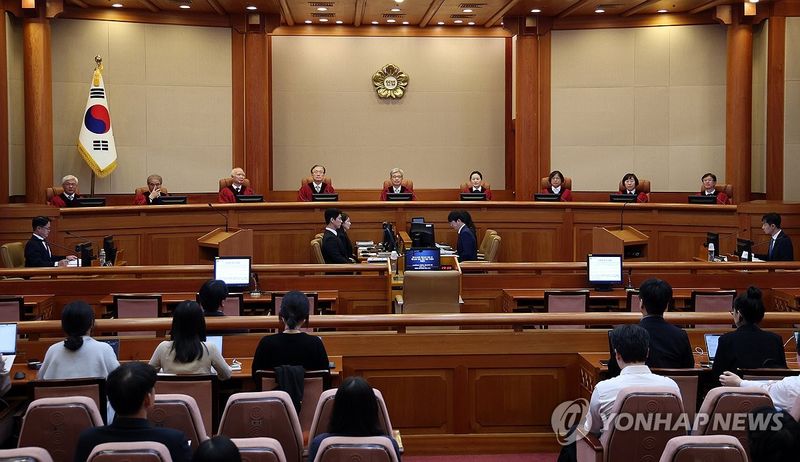
The Constitutional Court of Korea ruled on the afternoon of the 22nd, by an 8–1 vote, that the provision in Article 250(2) of the Criminal Act concerning “a person who murders his or her own lineal ascendant” does not violate the Constitution. The issue was whether the provision violated the principles of proportionality between culpability and punishment and of equality. The principle of proportionality between culpability and punishment requires a penalty to be commensurate with the seriousness of the crime and the offender’s responsibility. The statutory penalties for murdering a lineal ascendant are death, life imprisonment, or imprisonment for at least seven years—two years above the five-year minimum for ordinary murder.■ Son Who Neglected His Father to Death Challenged the Provision ItselfThe petitioner did not give his father, who had been discharged from the hospital in April 2021, his prescribed medication. He gave him only 10 therapeutic meals over seven days, although three were needed each day. For about eight days afterward, he withheld the therapeutic meals, water and medication and did not enter the room. His father died of pneumonia and other causes while severely malnourished.
The Daegu District Court sentenced him to four years in prison in August 2021, and the Daegu High Court also dismissed his appeal. While appealing to the Supreme Court, the petitioner sought a referral for constitutional review of the statute. After the Supreme Court rejected the request, he filed a constitutional complaint in May 2022.
The majority found a reasonable basis for the harsher punishment. It said that murdering a lineal ascendant not only takes a life but also damages the special bond and trust between parent and child and destroys the foundation of the family community. It also noted that the difference between the minimum sentences is only two years.
In response to the argument that a suspended sentence is effectively ruled out, the court said that a sentence commensurate with the offender’s responsibility could be imposed through statutory mitigation, including for diminished mental capacity, and mitigation based on extenuating circumstances. It also noted that the courts’ sentencing guidelines classify cases involving prolonged domestic violence as “murder with an extenuating motive,” for which they recommend lower sentences.■ Ma Eunhyeok: “Punishment Cannot Be Increased Even for Killing an Abusive Parent”Justice Ma Eunhyeok was the sole dissenter, finding the provision unconstitutional. His point was that the degree of blameworthiness in murdering a lineal ascendant varies greatly from case to case, but the provision makes no distinction.
Justice Ma said, “When lineal ascendants themselves abandon their duties and repeatedly engage in violence, turning the family community into a place that threatens human dignity, it is difficult to justify increasing the punishment on the grounds of values such as respect and gratitude—even for a victimized lineal descendant who kills a lineal ascendant in the course of struggling to protect their own dignity.”
He cited empirical research as evidence. A 1995 survey found that abuse by the victim was the motive in 26.2% of parricide cases. A study analyzing first-instance guilty verdicts handed down from 2020 to 2022 also found that in 14.5% of cases, the motive was the victim’s domestic violence or other adverse family circumstances.
Justice Ma noted that because the minimum sentence is seven years, even with mitigation for extenuating circumstances, an actual prison sentence of at least three years and six months is unavoidable, leaving no room for a suspended sentence. He also said that even under the ordinary murder provision, the maximum penalty is still death, so cases involving especially egregious breaches of filial duty can continue to be punished severely.
In July 2013, the Constitutional Court of Korea also upheld the same provision in a 7–2 ruling. The provision was carried over from Article 200 of Japan’s Criminal Code, which was applied in Korea under the Joseon Criminal Order during the colonial period, into Article 250(2) of South Korea’s 1953 Criminal Act. In Japan, however, the Supreme Court of Japan—the counterpart of South Korea’s Supreme Court—ruled the provision unconstitutional in 1973, and it was removed in a 1995 amendment.
[email protected] Kim Dong-kyu Reporter