Weight yo-yoing—losing and regaining—may signal a risk of death in old age [Health Check]
- Input
- 2026-10-22 17:03:58
- Updated
- 2026-10-22 17:03:58
[Financial News] It may be too soon to feel reassured just because your weight is the same now as it was a few years ago. If it has fluctuated significantly in the meantime, the risk of death among people aged 75 and older may be more than 40% higher.
A research team including Professors Seo Ji-yeon and Choi Ji-min of the Division of Gastroenterology at Seoul National University Hospital Gangnam Center and Professor Han Kyung-do of Soongsil University said that its analysis of about 620,000 people aged 75 and older found that the greater the weight fluctuations, the higher the risk of death. The risk was also higher among people whose first and last recorded weights were similar if their weight had fluctuated significantly in between.
In old age, weight can easily change because of illness or frailty. Until now, attention has focused mainly on how much weight people lost or gained, but how much their weight fluctuated across multiple measurements may also help assess their health.
Using health screening data from the National Health Insurance Service, the research team analyzed 616,696 people aged 75 and older who underwent health screenings between 2012 and 2015 and had at least four recorded weight measurements. The participants’ average age was 78, and the team tracked whether they died and the causes of death through the end of 2022. The median follow-up period was 7.5 years, during which 195,585 people died.
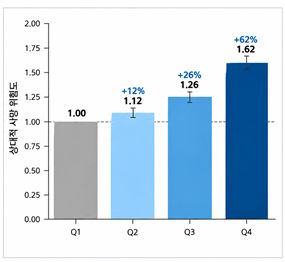
When the participants were divided into four groups according to the degree of weight fluctuation, the risk of death in the other three groups was 12%, 26%, and 62% higher, respectively, than in the group with the least fluctuation, with the risk rising as fluctuations grew larger. The analysis accounted for factors that could affect mortality risk, including age, sex, lifestyle, and comorbidities.
A clear difference was also found among people who had “maintained” their weight, with no more than a 5% difference between their first and last recorded weights. Those whose weight fluctuated significantly in between had a 41% higher risk of death than those whose weight remained relatively stable.
The same trend was seen among people who lost or gained weight. In the weight-loss group, people with large fluctuations had a 36% higher risk of death than others in the same group; in the weight-gain group, the risk was 33% higher. Here, “people with large fluctuations” refers to those in the top 25% of all participants for weight fluctuation. This means that it is important to consider not only whether a person ultimately lost or gained weight, but also how much their weight fluctuated along the way.
However, this was an observational study based on health screening data and did not prove that weight fluctuation directly causes death. Illness or frailty may also have affected both weight changes and the risk of death.
Professor Seo Ji-yeon said, “When a person’s first and last recorded weights are similar, it is easy to assume that their weight did not change much, but it is also worth looking at the changes in between.” She added, “This study shows that records of weight measured multiple times can be helpful when assessing the health of older adults.”
Professor Choi Ji-min explained, “When an older adult’s weight changes significantly, it is important to consider whether illness or changes in nutritional status may be behind it.” She added, “Regularly measuring weight and reviewing its trajectory during medical appointments may help assess the health of older adults.”
The findings of the study were published in the international journal Scientific Reports.
[email protected] Jung Myung-jin, Medical Correspondent Reporter