LG Electronics, Korea Water Resources Corporation to Collaborate on AI Transformation at Sihwa Lake Tidal Power Plant
- Input
- 2026-10-22 17:01:40
- Updated
- 2026-10-22 17:01:40
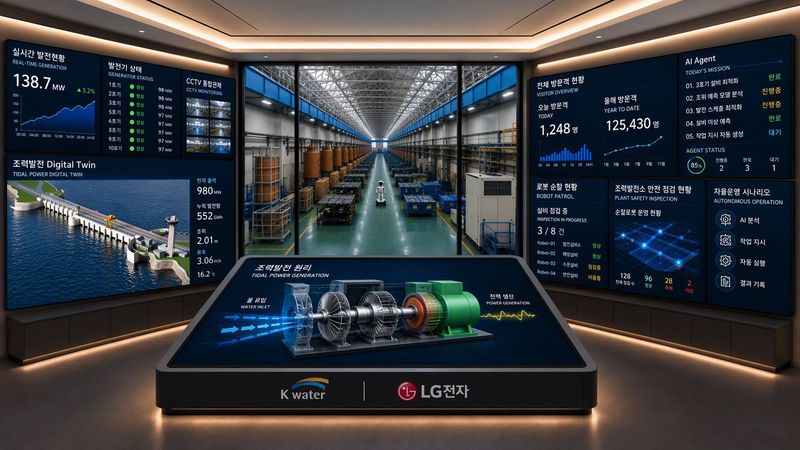
[Financial News] LG Electronics is applying smart factory technologies developed at manufacturing sites to tidal power plants. Together with the Korea Water Resources Corporation, it is pursuing ways to improve operational efficiency and safety at the Sihwa Tidal Power Plant using digital twins, artificial intelligence (AI) agents, robots and other technologies.
On the 22nd, LG Electronics signed an MOU with the Korea Water Resources Corporation at the Sihwa Tidal Culture Center in Ansan-si, Gyeonggi Province, on technical cooperation to advance the Sihwa Lake AI Tidal Power Plant. Among those attending the signing ceremony were Oh Bong-geun, head of the Korea Water Resources Corporation’s Renewable Energy Division, and Lee Seung-gi, head of LG Electronics’ Smart Factory Solution Center.
The two companies will combine the Korea Water Resources Corporation’s experience and data in power plant operations with LG Electronics’ smart factory development capabilities to assess potential applications for AI technology. They will also collaborate on demonstrations of AI, digital twin and robotics technologies, research and development (R&D) related to renewable energy and AI transformation, responses to policy initiatives, and the identification of overseas business opportunities.
They will first pursue the implementation and demonstration of an integrated operations system based on digital twins. This involves creating a virtual model of the entire power plant and linking it with real-time data from power generation equipment, CCTV cameras and other sources. The system will enable integrated monitoring of plant operations and support power generation forecasts, validation of operating scenarios, and diagnosis of equipment conditions.
The companies will also consider introducing power plant-specific AI agents using EXAONE from LG AI Research. The technology analyzes weather and sea-level changes, equipment conditions and power generation data to recommend operating plans, and supports analysis of the causes of power generation losses, detection of anomalies, predictive maintenance, risk assessments and optimization of inspection schedules. Trained on operational data and technical documents, it can help with decision-making and repetitive tasks such as report writing.
The companies will also work together on physical AI for on-site automation. They will pursue applications such as facility patrols, equipment inspections and hazardous-area monitoring using multifunctional patrol robots and AI CCTV cameras. They also plan to develop ways to automate the storage, management and supply of spare parts, as well as material transport, using industrial robots.
The aim is to improve efficiency across management operations by using both an operations system that analyzes power plant data and robots that inspect the site.
With this collaboration, LG Electronics is expanding its smart factory solutions business from manufacturing and logistics into energy and public infrastructure. Cumulative orders for the business topped 1 trillion won in the first half of this year, just two years after its launch. Initially, the company focused on customers in electronics, automotive components and battery manufacturing, and has recently expanded its customer base into logistics.
LG Electronics plans to validate the technology’s potential at the Sihwa Tidal Power Plant, the world’s largest by power generation capacity, and use the results to expand its participation in domestic and overseas energy infrastructure projects.
“It is highly significant that LG Electronics is applying the smart factory capabilities it has built up at manufacturing sites to the public infrastructure sector,” said Lee Seung-gi, head of LG Electronics’ Smart Factory Solution Center. “Together with the Korea Water Resources Corporation, we will support the digital transformation of the Sihwa Lake tidal power plant and continue to improve its operational efficiency and safety.”
[email protected] Jiyeon Park Reporter