BOK Governor Hyun Song Shin launches pointed criticism of government inflation and fiscal policies
- Input
- 2026-10-22 16:45:02
- Updated
- 2026-10-22 16:45:02
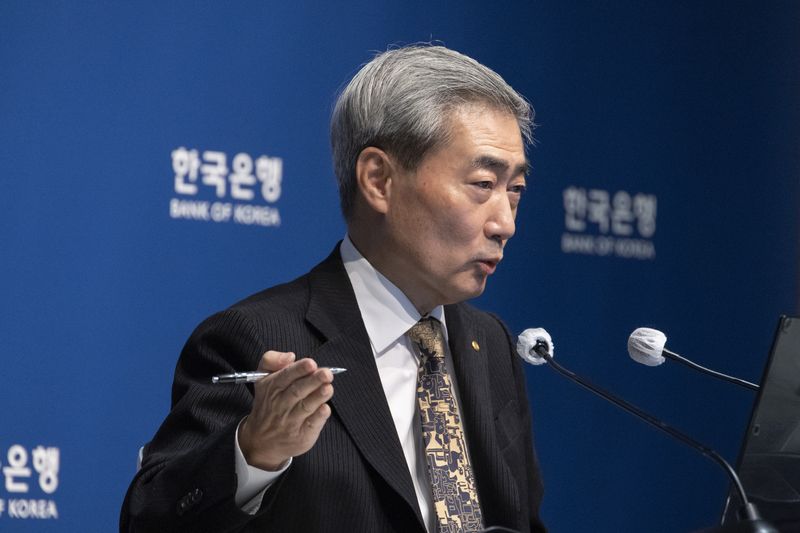
[Financial News] BOK Governor Hyun Song Shin spoke out unusually critically on the 22nd about the government’s record-setting expansionary fiscal policy and artificial price-control measures. He made a series of pointed remarks, including, “The government’s expansionary fiscal policy adds to aggregate demand and inflationary pressures in the short term, raising concerns about fiscal sustainability,” and “If the oil price cap system continues for too long, it will distort the price structure and fail to curb consumption.” Compared with his early-tenure approach of aligning with government policies and maintaining a cautious stance, his comments are seen as a more forthright expression of his convictions.
Marking six months in office, Governor Shin chaired the Monetary Policy Board that day, and all seven members unanimously decided to leave the base rate unchanged. At a press conference held immediately after the meeting, he offered a point-by-point critique of the government’s inflation and fiscal policies, drawing on the BOK’s analysis.
He first expressed partial agreement with concerns about a mismatch between monetary tightening and expansionary fiscal policy.
Governor Shin pointedly remarked, “The government’s expansionary fiscal policy can stimulate aggregate demand in the short term and add to inflationary pressures.”
Buoyed by a record semiconductor tax windfall, the government has drawn up next year’s budget proposal with total spending of 821 trillion won, the largest ever. In response, market concerns have continued that the BOK has shifted to monetary tightening while the government is poised to inject massive fiscal funds, and that the policy mismatch will blunt the effects of both.
Citing the BOK’s analysis that next year’s government budget proposal will raise gross domestic product (GDP) growth by 0.5 percentage points and inflation by 0.06 percentage points, Governor Shin said, “Government transfer spending (such as various subsidies) has a fiscal multiplier of around 0.2”—a low figure. He criticized, in particular, spending programs that offer benefits for political favor, saying they have little effect on growth because they do not lead to significant real investment and consumption.
The remark is seen as an indirect emphasis on his view that the government’s greatly increased revenues from the semiconductor boom should not be poured into populist cash-spending programs, but should instead be properly directed toward future investments that raise potential growth.
Governor Shin went on to express strong concern about fiscal sustainability.
He pointed out, “If government budget funds go toward ongoing fiscal spending items (programs), they become difficult to reverse (when fiscal tightening is needed), which is a concern from the perspective of fiscal sustainability.”
Governor Shin also urged, “Does a low fiscal multiplier mean we can be completely reassured? We must always think about sustainability,” adding, “If one-off resources give rise to ongoing spending (items), we need to pay particular attention and monitor fiscal sustainability.”
He continued his pointed criticism of the oil product price cap system, which has been in place for six months.
Governor Shin said that the oil price cap system “played a major role in preventing cost pass-through and curbing consumer prices,” but added sharply, “However, it distorts the price structure, and consumption needs to be curbed—but it isn’t.” He went on to point out, “The International Monetary Fund (IMF) has also repeatedly recommended that ‘subsidies for energy prices should not continue for too long,’” adding, “If they continue for a long time, they will cause many problems for public finances.”
The oil price cap system is a forceful inflation-control measure that the government brought back for the first time in 30 years after international oil prices surged in March this year in the wake of the Arab-Israeli conflict. At the outset, the government promoted the policy by demonstrating that it could lower inflation by up to 0.6 percentage points. But as the system has remained in place for several months, public awareness of the need to conserve fuel has waned, while side effects—including distortions to market functions—have grown. In particular, the government is using public funds to compensate refiners for losses. After repeatedly freezing gasoline and diesel prices at around 1,770 won per liter, the compensation bill is now estimated at 7 trillion to 8 trillion won. The government considered ending the price cap when international oil prices briefly eased during a temporary ceasefire between the US and Iran, but has been criticized for missing the opportunity.
Governor Shin’s pointed remarks are also drawing attention because they came after opposition lawmakers recently argued during a parliamentary audit that the BOK, as an independent monetary policy authority, should play a role in checking the government’s expansionary fiscal policy.
During the parliamentary audit, Governor Shin was criticized for the BOK’s failure to fulfill its role in connection with the introduction of single-stock leveraged exchange-traded funds (ETFs), which were singled out as a potential trigger for stock-market volatility. He acknowledged his misjudgments and mistakes and even bowed his head. In June, the BOK had issued a Financial Stability Report assessing that leveraged ETFs would help prevent domestic investment funds from flowing overseas and increase foreign fund inflows, without having warned of the risks of leveraged products around the time the ETFs were introduced in May this year.
[email protected] Jung Sang-gyun Reporter