“Faction Isn’t a License to Distort History”... Experts Take Aim at ‘The Assassin(s)’
- Input
- 2026-10-22 16:59:20
- Updated
- 2026-10-22 16:59:20
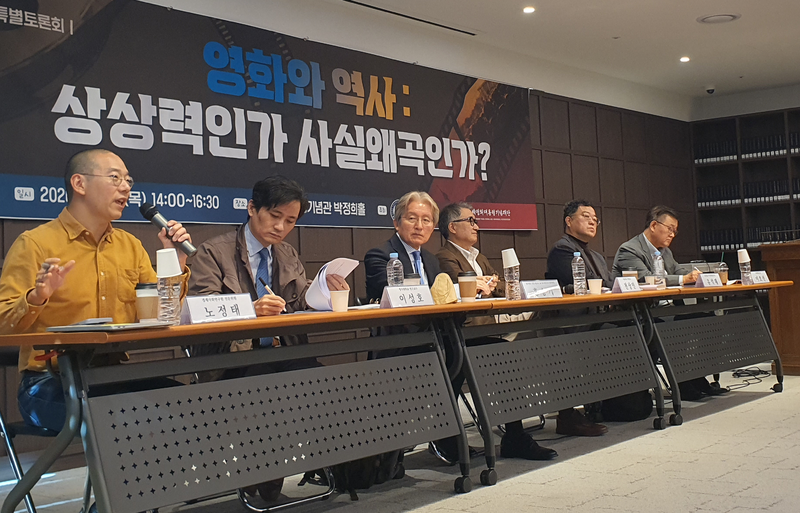
On the 22nd, the Park Chung-hee Academy held a special forum on the theme “Film and History: Imagination or Distortion of Fact?” at the Park Chung-hee Presidential Memorial Hall in Seoul’s Mapo District. Attendees included No Jeong-tae, senior research fellow at the Institute for Economic and Social Research; Lee Seong-ho, research professor at Myongji University; and Jeon Sang-in, professor emeritus at Seoul National University.
Participants argued that filling gaps between historical facts with imagination should be distinguished from depicting already verified facts differently. Since works based on real people and events can shape the public’s understanding of history, creators should also consider how to distinguish and present fact and interpretation, and conjecture and fiction.
Yoo Seok-jae, a history and culture reporter, took issue with the film for suggesting a possibility that differed from the established investigation findings into the shooting of the late Yuk Young-soo, while implying the involvement of the Korean Central Intelligence Agency and the Presidential Security Service, among others. He also pointed out that the shooting had no connection to the events portrayed when the film linked its journalists’ pursuit of the truth to the 1974 Declaration for the Practice of Freedom of the Press.
He said, “Faction or an open ending is no all-purpose key that gives you license to distort history,” adding that the filmmakers should have considered the possibility that audiences might confuse fact and fiction, especially since the film included actual archival footage.
Professor Lee Seong-ho said, “Freedom of expression must be absolutely guaranteed,” but also said, “You must not distort undeniable historical facts and tragic events and mislead people into thinking they are the truth.” His point was that using historical suspicions and political controversies as material to draw audiences could turn even social conflict into a commodity.
The possibility of legal liability was also raised. Professor Lee Ho-seon argued that the filmmakers could not escape responsibility simply by explaining that they had only posed questions within the realm of imagination. Citing past court rulings concerning films such as ‘The President’s Last Bang,’ he explained that if actual records and fiction are mixed in a way that could lead audiences to accept them as fact, legal issues such as defamation could arise.
No, the senior research fellow, also took issue with the film’s approach of creating an impression that the incident had a hidden backstory rather than presenting clear evidence. He said, “The boundary between fiction and fact must be clear,” and pointed out that a persuasive narrative is needed to support a possibility that runs counter to actual evidence and testimony. Attorney Hong, while acknowledging that reinterpreting historical figures in a new way falls within the realm of creative expression, stressed, “That entails responsibility.”
Meanwhile, ‘The Assassin(s)’ had drawn a cumulative audience of 3,295,125 as of the 21st.
[email protected] Choi Seung-han Reporter