“Will intervene if compensation for hacking victims is inadequate” ... KMCC to review compensation adequacy
- Input
- 2026-10-22 16:23:25
- Updated
- 2026-10-22 16:23:25
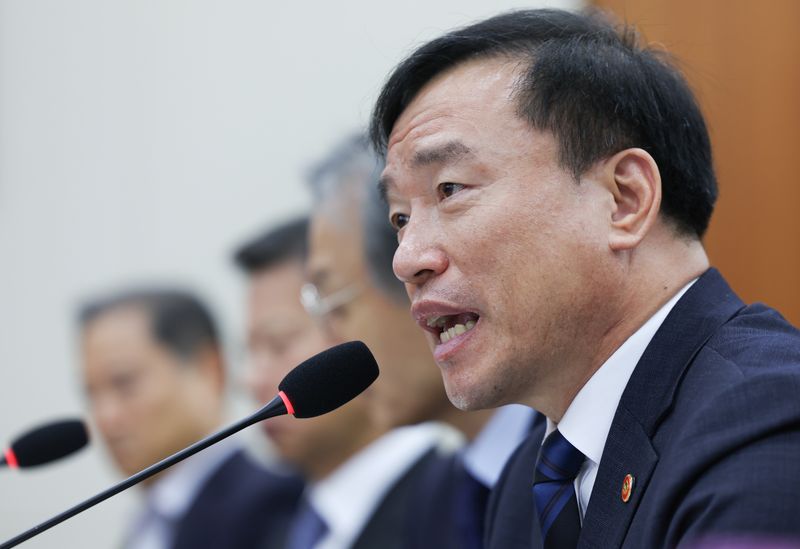
[Financial News] The Korea Media and Communications Commission (KMCC) said it would review whether compensation for users affected by hacking incidents at telecom companies and online platforms was adequate and actively pursue redress for them. It made clear that the KMCC could intervene directly if businesses’ compensation measures were inadequate, and also signaled that it would strengthen the response system to protect users.
Kim Jongcheol, chair of the KMCC, made the remarks on the 22nd regarding redress for users affected by hacking incidents, during a comprehensive parliamentary audit by the National Assembly’s Science, ICT, Broadcasting, and Communications Committee.
KMCC signals it may intervene if compensation for hacking victims is inadequate
That day, Rep. Cho Kyoung-tae of the People Power Party said that although hacking and personal information breaches were occurring repeatedly at telecom companies and online platforms, the KMCC’s measures to protect users were inadequate. He said this contrasted with the Ministry of Science and ICT’s steps to restrict carriers from recruiting new subscribers, waive early termination fees, and inspect measures to prevent recurrences, as well as the Personal Information Protection Commission’s (PIPC) responses, including imposing administrative fines and issuing corrective orders.
“The law establishing the KMCC explicitly sets out its functions in telecommunications regulation and user protection,” Rep. Cho said, calling on the commission to take a more active role in providing redress to affected users.
Kim responded, “The Ministry of Science and ICT handles the breach incidents themselves, while the PIPC handles personal-information-related matters. The KMCC is responsible for post-incident matters, including user protection and redress. There are areas where it can intervene if compensation or user-protection measures are inadequate.” He said the commission would address gaps in the response system.
When Song Ki-heon, chair of the National Assembly’s Science, ICT, Broadcasting, and Communications Committee, asked whether the KMCC could also be involved in telecom companies’ decisions on compensation amounts, Kim said, “It is the commission’s role to examine whether compensation is sufficient, even when it has been paid. Because we manage users’ interests after an incident occurs, it may appear that there is no response, but we are currently preparing measures and will work to ensure that actions stipulated in the terms and conditions are fully implemented,” he stressed.
Caution urged over blanket restrictions on teens’ SNS use ... Strengthen platform responsibility
The comprehensive parliamentary audit also saw continued discussion of restrictions on teenagers’ use of social networking services (SNS) and online platforms’ responsibility to protect them.
Rep. Kim Nam-guk of the Democratic Party of Korea (DPK) stressed that platforms’ responsibility to protect young people should be strengthened rather than imposing blanket restrictions on their SNS use. The point was that restrictions should be approached cautiously, especially because young people use SNS to express their opinions and form relationships with others.
Kim responded, “The general view is that uniform, across-the-board regulations are not appropriate,” adding, “We do not regard young people simply as subjects of regulation and protection.”
The KMCC is currently holding meetings with teenagers, parents, and experts, and is also providing legislative support for related bills pending in the National Assembly. Kim said the commission regards young people as agents who exercise their rights and will explore legislative options through consultations and public deliberation.
The need to strengthen online platforms’ protective measures for children and teenagers was also raised. Rep. Lee Jung-heon of the DPK pointed out that children can easily connect with unfamiliar adults through services such as ChatGPT for Kakao Open Chat and Danggeun, and called for platforms to put preventive safeguards in place. “Teaching children to watch out for cars alone cannot prevent accidents,” he said. “Are platforms stepping in to block dangerous approaches before children are exposed to danger?” He added that the KMCC had not obtained data on the scale of children’s and teenagers’ use of anonymous, open chat services, the extent of harm, related complaints and fact-finding surveys, or policy research.
Kim acknowledged that the commission’s understanding of the actual situation regarding youth protection was inadequate, saying, “Platform operators are primarily responsible for self-regulation, while the government supports them by strengthening systems such as those governing responsibility for youth protection.” He added, “Going forward, we will strengthen global operators’ public accountability through legislation.”
[email protected] Choi Hye-rim Reporter