Costs sought after substitute execution without an order over waste leachate leak... Constitutional Court of Korea rules law constitutional
- Input
- 2026-10-22 17:24:20
- Updated
- 2026-10-22 17:24:20
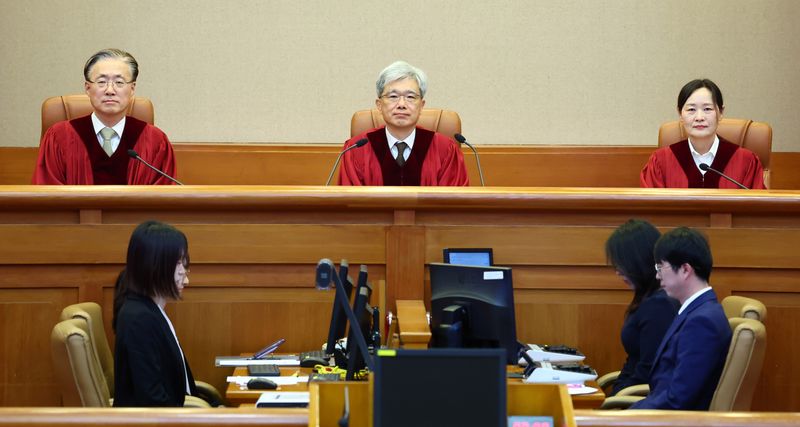
[Financial News] The Constitutional Court of Korea ruled that a legal provision allowing the relevant administrative authority, in emergencies such as leachate leaking from neglected waste or a fire breaking out, to carry out substitute execution without first issuing a separate order to take corrective action and collect the costs from waste generators and others does not violate the Constitution.
On the 22nd, the Constitutional Court of Korea ruled, by unanimous opinion, that some provisions were constitutional and dismissed the remaining claims in a constitutional complaint brought by 22 companies, including foundry manufacturer Company A, challenging Article 49(2)(3) of the Waste Management Act and other provisions.
From February 2011 to September 2015, Company A and others entrusted Company B, a waste recycling company, with handling chemically bonded waste foundry sand generated during product manufacturing. Company B used it to make fill material and then buried it in an abandoned quarry in Iksan, North Jeolla Province. Leachate flowed into a nearby stream, causing environmental pollution, including the mass deaths of fish.
The mayor of Iksan, concerned that residents’ health and the surrounding environment could face serious harm, carried out substitute execution in May–July 2021 without first issuing a separate order to take corrective action. The work included relocating the waste (moving it elsewhere) and covering it over (so it could no longer be seen). In July of the same year, the mayor ordered the claimants to pay the costs of the substitute execution.
The companies filed lawsuits seeking to overturn the orders to pay the costs and then petitioned for referrals to review the constitutionality of the relevant provisions of the Waste Management Act. After their petitions were denied or dismissed, they filed constitutional complaints.
The issue was whether the “emergency provision” added to the Waste Management Act in 2019 could also apply to companies that had entrusted waste for disposal in the past. The previous law permitted substitute execution and collection of the costs only when an order to take corrective action had not been followed. The amended law, however, allowed such an order to be omitted when there was a risk of urgent environmental pollution.
The Constitutional Court of Korea ruled that the provision did not violate the principle prohibiting retroactive legislation, a constitutional principle that bars applying newly enacted laws to past facts. The Court explained, “Even if the waste was treated (landfilled) before the emergency provision took effect, if it remained neglected after the provision took effect, the situation had not ended and constituted an ongoing fact.”
The Court also rejected the claim that the principle of protecting legitimate expectations had been violated. It said, “The claimants’ trust or expectation that an order to take corrective action would be issued before substitute execution cannot be considered absolute in every case.” The Court noted that the emergency provision had only relaxed procedural requirements by allowing the order to be omitted; it had not expanded the scope of substitute execution or increased its costs. The companies could also have avoided the expense by removing the waste themselves.
In particular, the Constitutional Court of Korea ruled that the public interest in protecting residents’ health and living environment outweighed the companies’ reliance interests, saying, “When leachate leaks or a fire breaks out, issuing an order to take corrective action and allowing time to comply could instead cause greater harm and make it more difficult to deal with the waste.”
The Court dismissed the claim challenging a provision that allows applications for property searches, provisional attachments and similar measures to preserve the right to collect the costs of substitute execution. It found that the provision did not apply to the lawsuits seeking to overturn the orders to pay the costs and therefore was not a prerequisite to adjudication. In other words, a case concerning that provision must be pending before a court.
[email protected] Choi Eun-sol Reporter