President Lee: “Concentrating the fruits of growth solely in large corporations undermines national potential”
- Input
- 2026-10-22 15:52:24
- Updated
- 2026-10-22 15:52:24
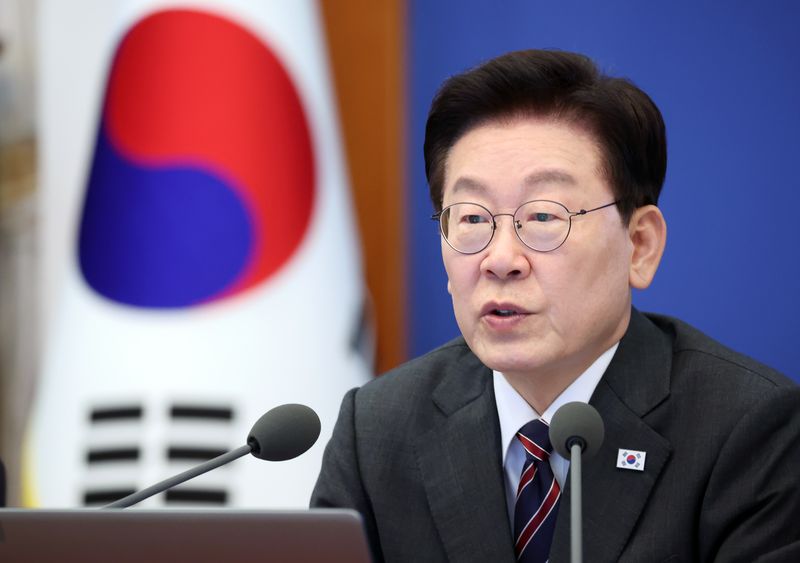
[Financial News] President Lee Jae Myung said on the 22nd, “If the fruits of growth are concentrated solely in large corporations, disparities within the economy will widen and polarization will deepen, undermining the country’s growth potential,” stressing the need to build an industrial ecosystem in which large and small businesses grow together. With the International Monetary Fund (IMF) forecasting that Korea’s potential growth rate will rise for the second consecutive year, the call is to spread the benefits of growth across the economy—including small and medium-sized businesses, young people and domestic demand—instead of concentrating them in a handful of companies.
At the Senior Presidential Aides Meeting he chaired at Cheong Wa Dae that day, President Lee said, “For this rare rebound in the potential growth rate to lead to qualitative improvements in the national economy, we need to build an industrial ecosystem in which large and small businesses grow together.”
In particular, he stressed, “Growth that leaves out small and medium-sized businesses, which account for at least 80% of all jobs, is neither sustainable nor desirable,” adding, “We need to fundamentally renew the paradigm of mutually beneficial cooperation between large and small businesses so they can grow together in a balanced way and drive growth in the national economy.”
He continued, “In step with the development of artificial intelligence (AI) and industrial restructuring, we need to expand the existing framework for mutually beneficial cooperation—which has focused on manufacturing and construction—to diverse areas such as platforms and finance.” He added, “We should work out tailored cooperation measures that promote collaboration between large and small businesses for national projects, including the Three Mega-Projects, seven Seed Projects and three core social policies.” He also urged, “I ask all ministries to join forces so that every economic player can share equally in this rare opportunity for a new leap forward for our economy, and the public can feel its effects.”
President Lee cited the IMF’s forecast that Korea’s potential growth rate would rise for the second consecutive year, saying that the economy had reached a turning point that could break its downward growth trend.
President Lee said, “As public expectations have risen for real growth to surpass 3% this year and national income to reach $40,000, the International Monetary Fund has projected that our potential growth rate will rise for the second consecutive year.” He added, “If this trend continues, the potential growth rate—which fell by almost 1% every time the government changed—will reach a historic turning point under our government.”
He added, “They say this is the first time in 40 years, since the mid-1980s, a period of rapid growth,” emphasizing the significance of the forecast coming amid unfavorable external conditions, including war in the Middle East and a global supply chain crisis, unlike during the “three lows” boom of the past.
President Lee stressed, “The rebound in the potential growth rate, which can be considered the economy’s basic strength, is truly welcome news that the foundations for growth in our economy are becoming stronger.” He added, “We should use this trend as a catalyst for moving toward greater, more sustainable and balanced growth.”
However, he voiced concern that imbalances in growth could become entrenched, with youth employment declining and the gap between exports and domestic demand persisting despite economic growth. President Lee noted, “Because of changes in the current industrial structure, avenues for young people to find jobs are narrowing even as the economy grows, and the gap between exports and domestic demand is not closing.” He added, “If these imbalances become entrenched, young people’s participation in economic activity will decline, and the opportunity for a rebound in the potential growth rate could be squandered as the domestic demand base weakens.”
He said, “These problems must not be left entirely to the market,” and instructed officials, “Please put the fiscal resources we have secured to full use, in the amounts needed to expand youth employment, supply housing and stimulate domestic consumption.”
He also called for support for financially vulnerable groups in response to rising interest rates. President Lee said, “We need to strengthen support for financially disadvantaged people,” adding, “We must actively develop and mobilize fiscal and policy measures so that the South Korean economy can settle onto a new growth trajectory.”
Meanwhile, ahead of the fall festival season and Halloween, President Lee called for stronger safety management in areas where crowds gather. He said, “When it comes to public safety, doing too much is 100 times better than doing too little,” and added, “Please ensure that safety measures for frontline responders, especially firefighters and police officers, are drawn up more thoroughly.”
[email protected] Choi Jong-geun, Seong Seok-woo Reporter