If interest rates jump, Seoul’s outskirts will feel the pain first ... Will areas with heavy borrowing take a “direct hit”?
- Input
- 2026-10-28 06:00:00
- Updated
- 2026-10-28 06:00:00
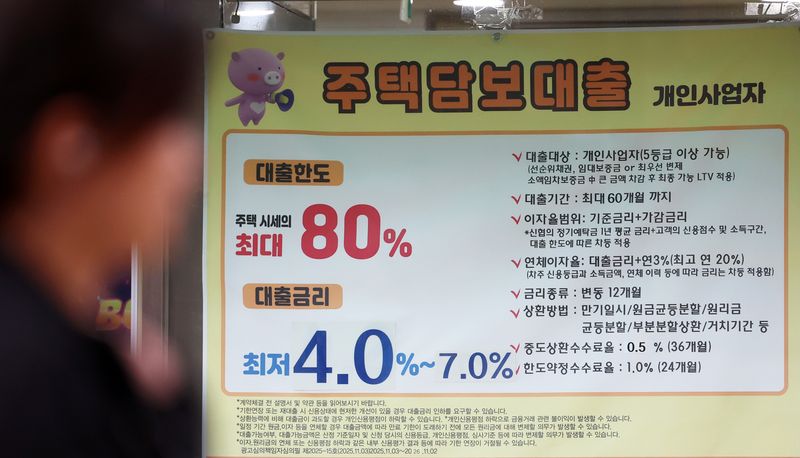
[Financial News] The burden is expected to grow relatively heavier in Seoul’s outlying areas, where reliance on borrowing is high, as mortgage rates continue to rise. Rates on mortgages at banks have already climbed into the mid-to-high 6% range, and with the possibility of further increases remaining, the market expects areas with a higher share of borrowing to be affected more heavily.
According to the Court Registration Information Plaza on the 27th, the average loan index for Seoul’s multi-unit buildings stood at 46.62 last September. The loan index measures the amount of mortgage liens registered as a proportion of the transaction value during sales of multi-unit buildings.
By district, reliance on borrowing tended to be higher in Seoul’s outskirts, where lower- and mid-priced homes are concentrated. Geumcheon District had the highest index at 58.13, followed by Seongbuk District at 55.46. Many outlying areas of Seoul were above 50, including Gwanak District at 53.58, Guro District at 53.54, Nowon District at 53.25, Gangseo District at 52.99, Jungnang-gu at 52.86, Dobong District at 52.58 and Gangbuk District at 51.24.
By contrast, the index was lower in the Gangnam area, where high-priced homes are concentrated. Gangnam-gu was at 24.69, less than half the figure for Geumcheon District; Seocho District was at 29.17 and Songpa District at 32.71. Seongdong District was also at 32.29, while Mapo and Dongjak districts were both at 37.92, below the Seoul average.
After last year’s Oct. 15 real estate measures reduced mortgage loan limits, housing demand spread to Seoul’s outskirts and southern Gyeonggi, where there was relatively more scope to use loans. The concern is that demand that moved to areas with lower barriers to entry to avoid lending restrictions could face a heavier burden as interest rates rise.
As demand from first-time homebuyers and people in their 30s—groups that tend to rely heavily on loans—increased during this process, they are also expected to be more affected by rising interest rates. First-time buyers accounted for 51.4% of transactions involving Seoul multi-unit buildings in September. There were 8,324 first-time buyers, of whom 4,206 were in their 30s, accounting for 50.5%.
Mortgage rates at banks have already reached high levels. Rates on fixed-rate mortgages with five-year terms at the five major banks—KB Kookmin, Shinhan, Hana, Woori and NH NongHyup—range from 4.63% to 6.66% per year. Variable-rate mortgages with six-month terms range from 4.41% to 6.51% per year, with the upper end reaching the mid-6% range.
There is room for lending rates to rise further. The Bank of Korea held its base rate at 3.00% per year on the 22nd, but markets are anticipating the possibility of another increase. COFIX (the Cost of Funds Index), based on newly extended loans, also rose to 3.43% per year last September, up 0.25 percentage points from the previous month. This was the largest increase in three years and 10 months, since November 2022.
If COFIX, the benchmark for variable-rate mortgages, rises further, the increase could be reflected in borrowers’ mortgage rates after a time lag. Some observers say that a larger rise in rates could even lead existing borrowers to put their properties on the market.
Yang Ji-young, an expert committee member at Shinhan Premier Pathfinder, said, “The main factors currently affecting the housing market are interest rates and relocation demand,” adding, “The recent slight slowdown in buying in Seoul’s outskirts and the increase in demand shifting to monthly rentals can also be seen as reflecting the burden buyers face from higher interest rates.” She added, “If rates rise to a level borrowers cannot afford, properties owned by borrowers who previously took out loans to buy homes could also come onto the market.”
[email protected] Choi A-young Reporter