Low-PBR reprieve proves short-lived... 95% of securities stocks have a PBR below 1
- Input
- 2026-10-22 15:49:24
- Updated
- 2026-10-22 15:49:24
[Financial News] As South Korea’s stock market plunged in the second half, valuations of securities stocks—which had shown signs of improvement in the first half—have begun to slide again. As stocks that had once regained a PBR of 1 fell back below that level one after another, the share of low-PBR stocks topped 95%.
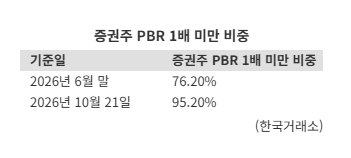
According to the Korea Exchange (KRX) on the 22nd, as of the previous day, 20 of the 21 securities-related stocks had a PBR below 1, accounting for 95.2% of the total. That was an increase of 19.0 percentage points from 76.2% (16 stocks) at the end of June.
PBR is an indicator of how a stock’s price is valued relative to the value of its equity. Generally, a PBR below 1 is interpreted to mean that a stock is undervalued to the point that its market capitalization is below its book net asset value.
Securities stocks have long been regarded as “perpetually undervalued.” As recently as the end of last year, 19 of the 21 securities stocks had a PBR below 1, or 90.5%. Valuations appeared to recover, buoyed by share-price gains in the first half of this year, but that improvement has stalled in the second half.
Korea Investment Holdings’ PBR rose to 1.07 at the end of the first half but fell to 0.74 by the previous day. Over the same period, Samsung Securities Co., Ltd. fell from 1.20 to 0.88, NH Investment & Securities from 1.17 to 0.95, and KIWOOM Securities Co., Ltd. from 1.35 to 0.88.
Valuations also generally declined among securities stocks that already had PBRs below 1. Daishin Securities’ PBR fell from 0.51 at the end of the first half to 0.44; Hanwha Investment & Securities Co., Ltd. from 0.51 to 0.43; SK Securities Co., Ltd. from 0.87 to 0.70; and Shinyoung Securities from 0.71 to 0.51.
Mirae Asset Securities was the only securities stock to maintain a PBR of 1 or higher. Its PBR had climbed as high as 1.88 at the end of the first half, but fell to 1.14 by the previous day.
The change among securities stocks is even more pronounced compared with the market as a whole. As of the previous day, 60.0% of all listed stocks in the KOSPI and KOSDAQ markets for which a PBR was calculated had a PBR below 1, up just 1.2 percentage points from 58.8% at the end of the first half. That is a limited change given that the KOSPI fell 32.3% and the KOSDAQ 13.5% in the second half.
The decline in securities stocks’ valuations is seen as the result of earnings uncertainty compounded by a weak stock market. In particular, as share prices have remained weak in the second half and trading activity has contracted, expectations for earnings have fallen.
However, some say that valuation appeal is coming to the fore, given that share prices have fallen excessively relative to earnings. Kim In, a researcher at BNK Securities, said, “PBRs and PERs in the securities industry are currently far too low,” adding, “The sharp drop in share prices has increased valuation appeal, and securities stocks are also attractive as defensive stocks given their high dividend yields.”
He went on to say, “The sharp decline in the stock market is expected to bring a substantial drop in earnings in the third and fourth quarters. However, given that the stock market began rising in earnest in the fourth quarter of last year and market interest rates were on an upward trend, earnings should be solid compared with the same period a year earlier.” He added, “Considering the effects of increased government spending, its commitment to economic stimulus, the implementation of productive finance, favorable stock market policies, and investor deposits that remain high, further sharp declines in the stock market will be limited.”
[email protected] Seo Min-ji Reporter