‘The power of semiconductors’: KOSDAQ-listed companies post 9.5 trillion won in first-half profits, up 60.4%
- Input
- 2026-10-22 14:58:05
- Updated
- 2026-10-22 14:58:05
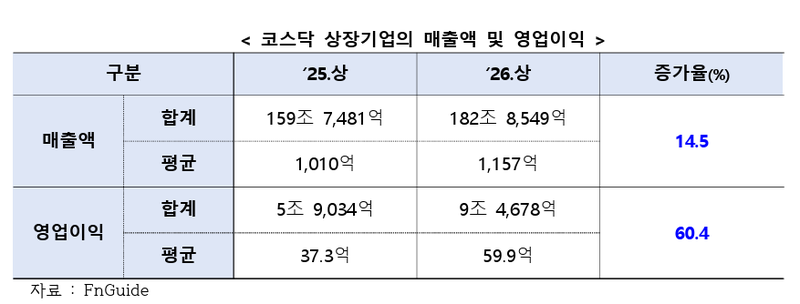
According to the ‘Analysis of Business Results of KOSDAQ-Listed Companies in the First Half of 2026,’ released by Industrial Bank of Korea on the 22nd, KOSDAQ-listed companies’ revenue and operating profit rose 14.5% and 60.4%, respectively, from the same period a year earlier. The bank’s analysis of KOSDAQ-listed companies’ results covers 1,581 of the market’s 1,727 listed companies that had results for the three-year period from 2024 through the first half of 2026.
The average operating margin of the companies surveyed was 5.2% in the first half of this year, up 1.5 percentage points from the same period a year earlier. By company size, operating margins were 6.2% for large KOSDAQ-listed companies, 5.8% for mid-sized companies and 2.8% for small and medium-sized companies. By industry, ‘semiconductors and related equipment’ posted the highest margin at 12.4%, up from 6.9% in the same period a year earlier, followed by medical equipment and services at 5.3%, media at 4.7%, and electronic equipment and devices at 4.4%. By contrast, the biotech industry recorded a loss for the second consecutive year, with a margin of minus 7.1%. The pharmaceutical industry’s margin was just 1.1%. Amid rising semiconductor prices, the operating margin of KOSDAQ-listed companies related to mobile phones improved from minus 0.5% a year earlier, but they barely managed to turn a profit, at 1.2%.
The debt ratio of large KOSDAQ-listed companies was 111.3%, nearly unchanged from 111.0% last year, while small and medium-sized companies maintained a low debt ratio of 60.7%. Among KOSDAQ-listed industries, auto parts had the highest debt ratio, at 141.7%.
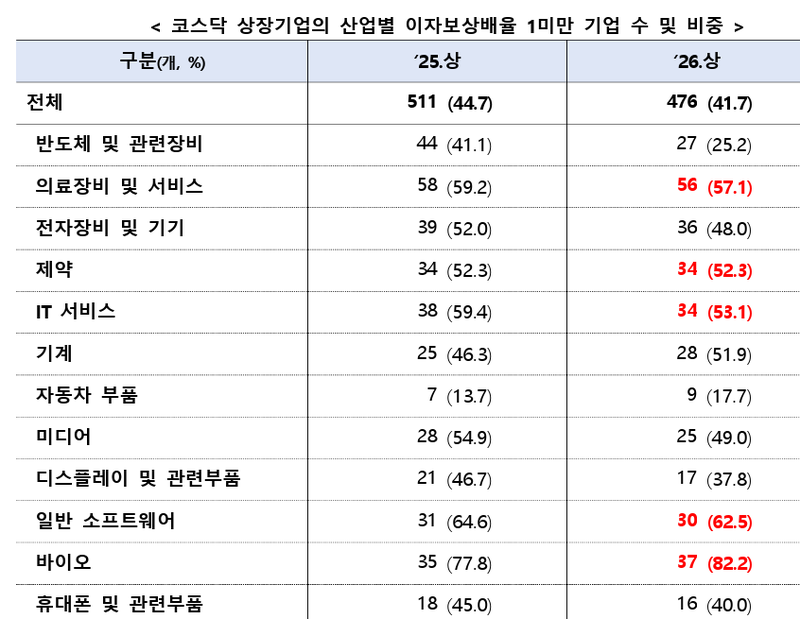
The number of companies with an interest coverage ratio below 1 in the first half of this year (among 1,142 companies with interest expense data) was 476, down 35 from the previous year. Their share fell 3.0 percentage points from the same period a year earlier to 41.7%. The number of companies with fully impaired capital was six, unchanged for the second consecutive year. Four companies had partially impaired capital (50% or more).
The survey was conducted as part of the ‘IBK KOSDAQ Market Revitalization TF’ initiative, which aims to reduce information asymmetry in the KOSDAQ market and improve market accessibility.
[email protected] Jo Eun-hyo Reporter