"Second Relocation of Public Institutions Should Be Linked to Regional Development"
- Input
- 2026-10-22 14:34:46
- Updated
- 2026-10-22 14:34:46
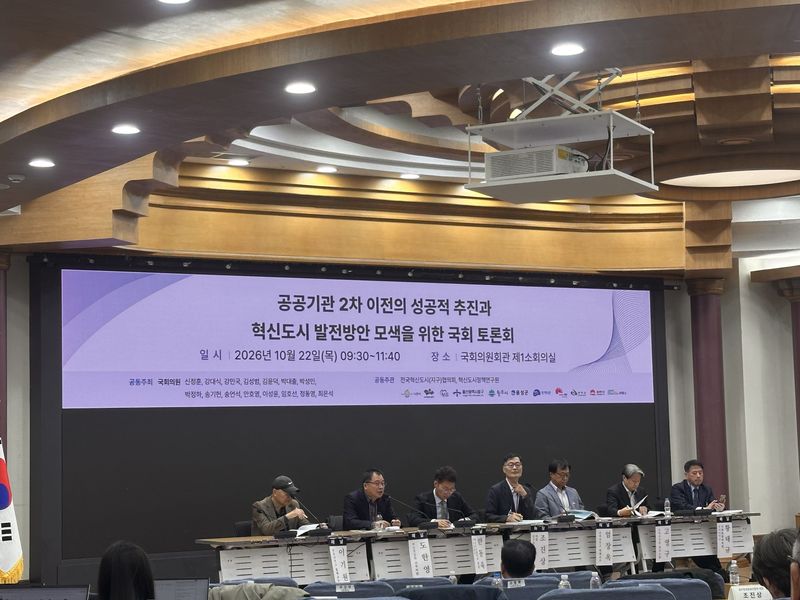
[Financial News] With the government planning to relocate public institutions based in the Seoul metropolitan area to other regions for a second time, experts urged it to ensure that the relocation brings about development that allows the regions and institutions to prosper together.
Fifteen lawmakers from the ruling and opposition parties held a symposium on the 22nd at the National Assembly Members' Office Building to discuss the successful implementation of the second relocation of public institutions and ways to promote the development of innovation cities.
Experts unanimously stressed that the second relocation of public institutions should lead to regional development. Lee Min-won, head of the Innovation City Policy Research Institute, who gave a presentation, said, "If the first relocation was about moving institutions, the second should lead to the transfer of authority and economic activity, people settling in the area, and the completion of the innovation city's growth cycle." The point was that while the first relocation of public institutions simply moved institutions, the second must create conditions that allow people to put down roots.
Ki-Won Lee, an emeritus professor at Hallym University, argued that support to help employees of the institutions settle in should take fairness toward nearby residents into account. He said, "While providing necessary initial relocation support, the focus should be on strengthening the foundations for daily life over the long term—such as spousal employment, children's education, healthcare and career opportunities for employees—rather than offering excessive one-time benefits." He added, "Alongside the rate of employees relocating with their families, we should monitor staff retention and satisfaction with life, but employees' difficulties must not be treated solely as grounds for blocking the relocation or as the individual's responsibility."
Ko Yeong-gu, director of the Institute for Regional Transition, said, "It is also important to create an urban environment that remains lively at night and on weekends." He explained, "Local governments should set regular hours for opening existing public facilities at night and on weekends, and reach cost-sharing agreements for facility management and safety."
He added, "In reality, it is difficult for an innovation city to become a perfectly self-sufficient city that provides all daily-life services on its own." He continued, "Innovation cities should expand into a broader regional living-area network, woven together with nearby large and small cities through education, healthcare, culture, transportation and industry."
Some also argued that building an ecosystem for related industries is central to the second relocation. Hwang Tae-gyu, dean of the Future Convergence College at Woosuk University, said, "The growth of industry ultimately depends on the growth of people, and the sustainability of industry is also determined by the innovative capabilities of local talent." He added, "We should shift from an innovation city policy centered on the Ministry of Land, Infrastructure and Transport and the Ministry of Trade, Industry and Energy to one centered on the Ministry of Education."
He said that, to this end, a new Innovation City Industry-Specific Education Ecosystem Development Project (working title) should be established and designed to include industrial experiences and career education for elementary school students; industry clubs and extracurricular activities for middle and high school students; and the restructuring of related university departments and the establishment of professional graduate schools.
Earlier, on the 3rd of last month, the government announced its "Principles and Directions for the Second Relocation of Public Institutions to Regional Areas." It plans to finalize and announce the plan for the second relocation of public institutions to regional areas in the fourth quarter of this year. The government said it would carry out this second relocation in accordance with five principles.
[email protected] Jeong Gyeong-su Reporter