Lee Chan-jin: “Bank lending spreads are a livelihood issue ... I’ll prepare measures, including disclosure”
- Input
- 2026-10-22 15:08:27
- Updated
- 2026-10-22 15:08:27
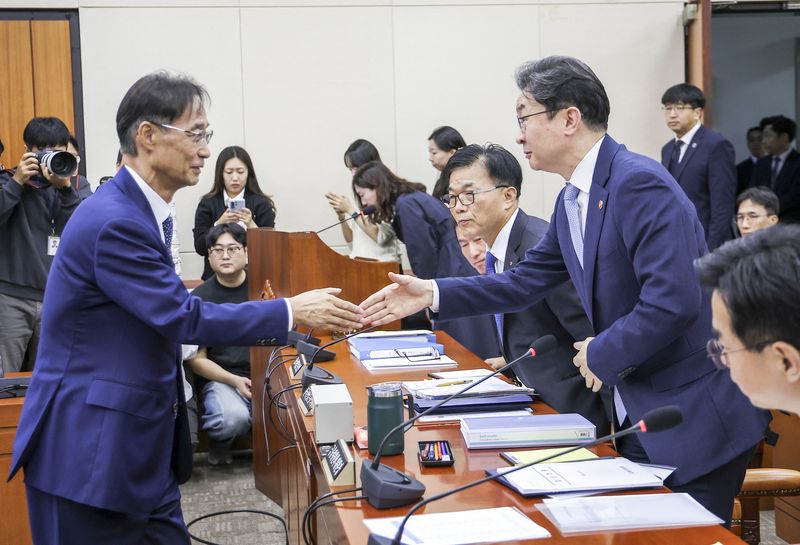
On the 22nd, Yoo Dong-soo, chair of the National Assembly’s National Policy Committee, said at a parliamentary audit in Yeouido, Seoul, that lending rates and the process for setting them should be disclosed to encourage competition among banks and strengthen consumers’ freedom of choice.
When Chair Yoo asked, “If lending rates and how they are set were disclosed, wouldn’t consumers be able to review them and make decisions, naturally encouraging competition among banks?”, Lee replied, “We are working to ensure that two systems—the consumer impact assessment and the inclusive finance assessment—operate properly.” Lee added, “We are preparing measures to strengthen consumer choice through ‘naming and shaming’—publicly identifying and shaming banks—including disclosure.”
When Chair Yoo again asked him to consider a disclosure system in detail, Lee replied, “I will prepare to do so.”
Min Byeong-deok, a lawmaker from the Democratic Party of Korea, said that the Banking Act, which restricts the inclusion of legal costs in lending rates and whose amendment he led, took effect on July 1. He presented data comparing each bank’s add-on and preferential rates in June and August, before and after the law took effect.
According to Rep. Min, BNK Kyongnam Bank’s add-on rate rose from 3.06% in June to 3.67% in August, an increase of 0.61 percentage points. Preferential-rate benefits also declined over the same period. Jeju Bank likewise raised its add-on rate while lowering its preferential rate. Banks typically calculate lending rates by adding an add-on rate to the benchmark lending rate and subtracting the preferential rate. Raising the add-on rate or reducing the preferential-rate discount increases borrowers’ interest burden.
Rep. Min criticized banks for changing add-on rates by adjusting their target returns, calling it “a full-fledged balloon effect.” He said that even if the law excludes costs borne by banks from lending rates, adjusting other items would undermine the amendment’s purpose of reducing customers’ interest burden.
Rep. Min also called for a joint special inspection by the Financial Services Commission and the Financial Supervisory Service. He said that the additional information recently obtained from five banks was limited to one representative product from each bank, and asked the FSS to review all products and report to his office whether it found any problems.
Rep. Min said, “On the 19th, only the heads of the five major banks appeared as witnesses, so we analyzed only those five. This time, we also looked at the remaining 17 banks.” He added, “We have confirmed that some banks raised add-on rates and even cut preferential-rate benefits after the Banking Act was amended.” Financial Services Commission Chairman Lee Eok-won said, “I’ll check with the FSS to see what the situation is.” Lee Chan-jin also said, “For the banking sector, separate from the issue of soundness, I will treat this as the most important matter related to people’s livelihoods.”
Earlier, on the 19th, Rep. Min said the five major banks had earned 44.4 trillion won in interest income in the first half of this year, criticizing them: “When they were told to lower add-on rates, they used a trick by cutting preferential-rate discounts.”
[email protected] Park Mun-su Reporter