Foreigners net-sell 13 trillion won in Samsung Electronics and SK Hynix alone in October; semiconductor rebound hinges on Big Tech earnings
- Input
- 2026-10-22 16:17:50
- Updated
- 2026-10-22 16:17:50
[Financial News] Foreign investors have net-sold more than 17 trillion won on the domestic stock market this month, with about 77% of the selling concentrated in Samsung Electronics and SK Hynix.
As the KOSPI swings between sharp declines and rebounds, third-quarter earnings and AI capital expenditure plans from U.S. Big Tech companies have emerged as factors that could determine the direction of domestic semiconductor stocks.
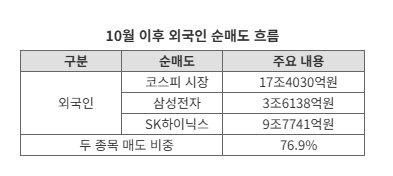
According to the Korea Exchange, foreign investors net-sold 17.403 trillion won on the KOSPI from the 1st through the 22nd. Net selling totaled 3.6138 trillion won in Samsung Electronics and 9.7741 trillion won in SK Hynix, amounting to 13.3879 trillion won in the two stocks alone. In effect, 76.9% of total net selling was concentrated in the two large-cap semiconductor stocks.
The KOSPI closed at 5,668.05 on the 16th, down 14.46% from a week earlier, then rebounded 3.29% on the 21st to 5,735.66. It plunged 3.52% again that day, however, closing at 5,533.77. As market volatility has increased, with sharp declines alternating with rebounds, heavy foreign selling and pressure from concentrated trading in large-cap semiconductor stocks are acting as major factors for the domestic market.
The key link between foreign selling and U.S. Big Tech earnings is the path from AI investment to demand for memory semiconductors. If major cloud companies such as Microsoft, Alphabet and Amazon expand investment in AI data centers, demand could rise for high-bandwidth memory (HBM) and server DRAM.
This affects memory prices and the outlook for revenue and earnings at Samsung Electronics and SK Hynix. Conversely, if Big Tech companies slow their investment or AI monetization falls short of expectations, expectations for future memory demand and earnings growth could also weaken. This is why foreign investors watch U.S. Big Tech earnings and investment plans as indicators of future earnings at domestic semiconductor companies.
Third-quarter results released by Tesla and Meta on the 21st were mixed. Tesla reported revenue of $28.046 billion, down 0.2% from a year earlier, and operating profit of $718 million, down 55.8%.
Meta reported revenue of $64.601 billion, up 26%, but operating profit fell 37% to $12.988 billion after $9.89 billion in costs related to a settlement in a lawsuit concerning adolescent mental health was factored in. Excluding that expense, operating profit rose 11% year over year to about $22.888 billion.
The Nasdaq has also recently swung between sharp declines and rebounds, as market views diverge on Big Tech earnings and the profitability of AI investment. Volatility is rising as growth expectations collide with the burden of investment costs, and this trend is also weighing on domestic semiconductor stocks.
Big Tech earnings announcements through the end of this month are key dates for gauging the direction of AI investment. In Korea time, Alphabet and Microsoft are scheduled to report early on the 29th, and Amazon early on the 30th. Apple is expected to report on November 3.
“Given that foreign selling on the domestic stock market has been concentrated in large-cap semiconductor stocks, U.S. Big Tech earnings and AI capital expenditure plans will be important factors in restoring investor sentiment,” a securities industry official said. “If the trend of increased investment continues and growth in cloud businesses provides support, expectations for memory demand at Samsung Electronics and SK Hynix may also be sustained. But if doubts about returns on investment grow, share-price volatility may persist.”
[email protected] Kang Jung-mo Reporter