“The rebound lasted a day; losses are snowballing” ... Investors sigh as retail investors alone prop up the market [fn Afternoon Market Update]
- Input
- 2026-10-22 13:32:31
- Updated
- 2026-10-22 13:32:31
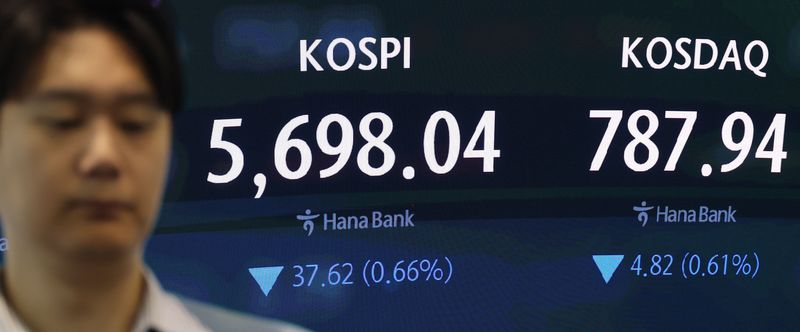
[Financial News] The previous day’s rebound was wiped out in a single day. As foreign investors and institutions dumped shares, retail investors were the only net buyers, but they could not prevent the index from falling. Investors who held on, hoping for a rebound after the sharp drop, were met with another widening of losses. The cycle of the market rising one day and sliding again the next is fueling investors’ fatigue and disappointment.
As of 1:25 p.m. on the 22nd, the KOSPI stood at 5,539.72, down 195.94 points (3.42%) from the previous trading day. It gave up the 5,700 level it had regained the day before with a 3.29% rise. During the session, it fell as low as 5,537.42, extending its decline to 3.46%.
The decline spread across the market. On the Korea Exchange’s main board, 675 stocks fell, more than three times the 196 that rose. The large-cap index fell 3.78%, a steeper drop than the mid-cap index (-0.84%) and small-cap index (-0.92%). Large-cap stocks, which had been expected to support the market, instead dragged the index down.
Leading semiconductor stocks also failed to hold on to the previous day’s rebound. Samsung Electronics was trading at 213,500 won, down 4.47% from the previous trading day. SK hynix stood at 1,215,000 won, down 6.11%.
Retail investors’ buying contrasted with selling by foreign investors and institutions. By trading value on the main board, retail investors were net buyers of 348.567 billion won. Foreign investors, by contrast, were net sellers of 231.459 billion won, while institutions were net sellers of 130.783 billion won. Among institutions, pension funds and others were net buyers of 127.019 billion won, but financial investment firms were net sellers of 297.586 billion won, leaving institutions as a whole with net selling.
KOSDAQ also gave back all of the previous day’s gains. At the same time, the KOSDAQ index stood at 770.72, down 22.04 points (2.78%) from the previous trading day. The decline was more than twice the previous day’s 10.79-point gain.
Since plunging 7.57% on the 15th, the KOSPI has continued to swing up and down, maintaining an unsettled trend. During the session on the 22nd, the index stood 40.98% below its 52-week high. KOSDAQ was also down 37.31% from its 52-week high.
Market expectations for corporate earnings have also risen. Strong earnings alone are no longer enough to guarantee a rise in share prices, and investors are increasingly looking to see whether large-scale artificial intelligence (AI) investments translate into actual cash generation and profits.
Kang Jin-hyuk, a senior researcher at Shinhan Investment & Securities, explained, “As the performance of individual companies does not prove the overall profitability of AI investment, earnings season continues to serve as a testing ground. Meta’s shift to negative free cash flow (FCF) is holding back a rebound, while Lam Research has also weakened despite strong earnings after issuing guidance in line with estimates, falling short of heightened market expectations.”
[email protected] Choi Doo-seon Reporter