“Even a moving car stopped with just the P button” ... The evolution of advanced safety technology
- Input
- 2026-10-22 12:45:13
- Updated
- 2026-10-22 12:45:13
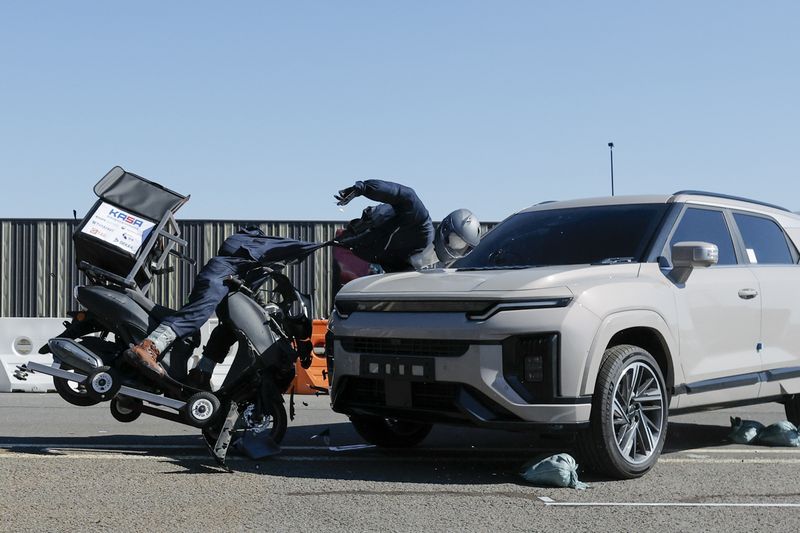
【Financial News, Daegu — Reporter Kim Dong-ho】“Bzzzzzz—bang.” When a motorcycle traveling at 40 km/h collided with a passenger car, a crash louder than expected rang out across the test site. Debris from the motorcycle and passenger car scattered across the road, and the legs of the crash-test dummy riding the motorcycle were torn off. Given that the speed limit on ordinary roads in Seoul is 50 km/h, it was a moment that brought home just how dangerous motorcycle crashes can be even at relatively low speeds.
■The dummy’s legs torn off in a collision at just 40 km/h
On the 22nd, visitors continued to arrive at the Daegu Driving Test Center of the Korea Intelligent Automotive Parts Promotion Institute (KIAPI) in Guji-myeon, Dalseong-gun, Daegu, despite the chilly morning temperature of 6°C and biting wind. Attendees braved the cold with hand warmers and blankets handed out by the organizers as they waited for the live vehicle collision demonstration at ‘K-CRASH 2026,’ hosted by the Korean Society for Automotive Mobility Safety.The first demonstration of the day was a collision test between a motorcycle traveling straight and a passenger car entering diagonally at a 45-degree angle. It recreated a common type of crash that occurs when a passenger car makes a U-turn or turns left. This type is said to account for more than 45% of actual motorcycle crashes.
The impact when the car and motorcycle collided was greater than expected. The vehicles were traveling at a speed commonly seen on real roads, yet parts of the dummy’s body were torn off. The demonstration particularly showed how vulnerable motorcycle riders are in crashes, without the protection of a vehicle body.
The collision test was designed based on data on 1,429 motorcycle crashes included in IGLAD, an accident investigation and analysis program. It focused on recreating the impact angles and driving conditions found in actual crashes to identify their characteristics and test how well safety technologies respond.
An automatic emergency braking (AEB) test followed, simulating the risk of a collision between a vehicle turning left at an intersection and a motorcycle. The test set up an exceptional situation outside normal testing conditions—an “edge case”—to assess the limits of advanced safety systems. It showed that although autonomous driving and Advanced Driver-Assistance Systems (ADAS) are advancing, validation reflecting a range of crash scenarios is needed to address the complex situations found on real roads.
Demonstrations of advanced safety technologies from Hyundai Motor Company and Kia Corporation also drew interest. In particular, the emergency braking function using the P button on an electronic shift lever was publicly demonstrated for the first time that day. In an emergency when it is difficult for the driver to press the brake pedal while driving, holding down the P button limits acceleration and applies braking force to all four wheels.
When the vehicle’s speed drops below 1 km/h, the electronic parking brake (EPB) engages automatically, bringing the vehicle to a complete stop. Unlike existing emergency braking systems that use the electronic parking brake, this system can brake without the driver having to move a hand far from the steering wheel. The feature was first introduced on the eighth-generation Hyundai Elantra unveiled by Hyundai this year, and provides an additional safety measure for situations in which the brake pedal is difficult to operate normally.
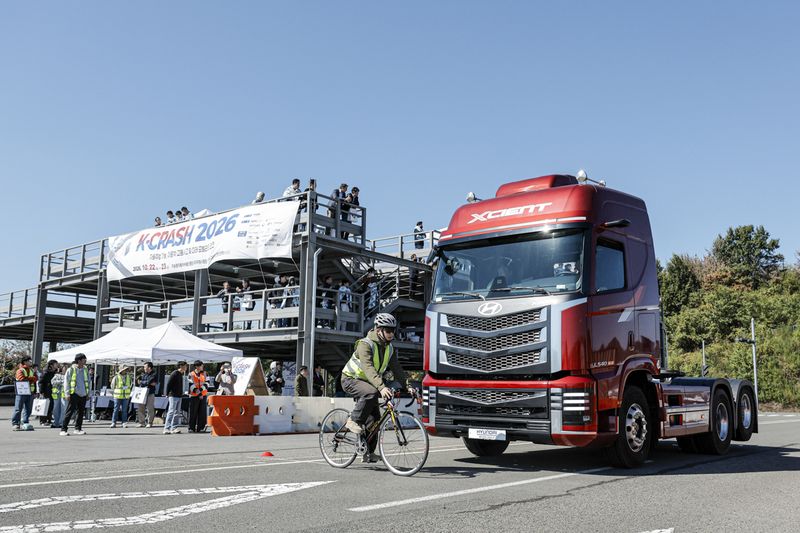
Commercial vehicle safety technology designed to meet European regulations concerning Blind Spot Information Systems (BSIS) was also unveiled. The technology detects and warns of road users, such as cyclists, in the side blind spots that fall outside a driver’s view when a large commercial vehicle turns, reducing the risk of a collision.
■Tracing crash causes through data, beyond reenactment
In the afternoon, a demonstration was scheduled to recreate an intersection crash involving two cars and extract data from the event data recorder (EDR). The test examines the limits of advanced safety technologies by simulating a situation in which the driver turns the steering wheel excessively while the forward collision-avoidance system (FCA) fails to operate.The event was significant in that it went beyond crashing actual vehicles to include the process of scientifically determining the causes of crashes. An EDR records key driving information, such as the vehicle’s speed, accelerator-pedal operation and whether the brakes were applied, before and after a crash. While a vehicle dashcam shows what happened in video, an EDR makes it possible to check the driver’s actions and the vehicle’s movements in numerical form.
As electronic vehicle controls and autonomous driving technology become more advanced, it is also becoming increasingly important to objectively verify the driver’s actions and the operating status of vehicle systems at the time of a crash. That is because accurately determining the cause requires analyzing not only the traces left at the crash scene but also data recorded inside the vehicle.
Kim Jeong-yun, chair of the Accident Investigation and Reconstruction Division of the Korean Society for Automotive Mobility Safety, said, “This year’s K-CRASH brought together motorcycle collision reenactments, autonomous driving and ADAS safety technologies, and analysis of event data recorder data in a single framework.” Kim added, “By linking up with FIX 2026, we have created an opportunity for field testing, the latest industry technologies and practical crash investigation to come together in a coordinated way. We will continue developing it into a specialized platform that leads to safer mobility technologies and systems, grounded in an understanding of actual crashes.”
[email protected] Kim Dong-ho Reporter