Inje County residents rise up over exclusion from population-decline areas and being placed in a city-level tier: “Review this immediately”
- Input
- 2026-10-22 11:43:40
- Updated
- 2026-10-22 11:43:40
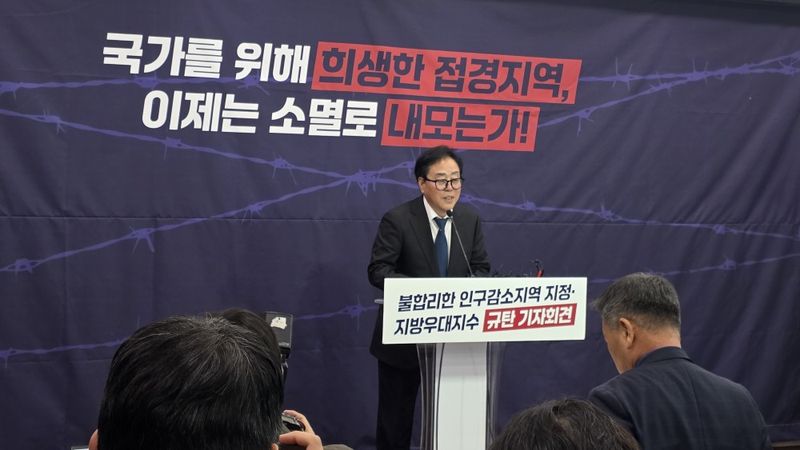
【Financial News Chuncheon = Reporter Kim Gi-seop】The residents of Inje County in Gangwon State have risen up, from the county chief and County Council to the heads of 85 villages, after the county—which has borne decades of restrictions to defend the country—was excluded from population-decline areas and grouped in the same tier as cities such as Chuncheon and Wonju.
On the morning of the 22nd, Inje County Chief Choi Sang-gi held a press conference in the briefing room of the Gangwon State Government and announced a statement calling for “improvements to the designation of population-decline areas and the calculation of the Local Preferential Index.” On the 19th, the government redesignated population-decline areas, leaving out Inje County and classifying it as a “Population Vitality Area.” In the Ministry of the Interior and Safety’s proposed tiers for the Local Preferential Index, Inje County was also placed in Tier 2, alongside Chuncheon, Wonju, Gangneung and Sokcho.
In his statement, County Chief Choi said that in the five years since Inje County was excluded from population-decline areas in 2021, its population had fallen by 1,397, and that it ranked only 151st among 167 cities and counties nationwide in last year’s Korea Development Institute (KDI) assessment of regional underdevelopment. He said statistics that include military personnel and their families obscure the reality of declining numbers of young people and children and worsening population aging. The amount of the Local Extinction Response Fund can differ by as much as fourfold between population-decline areas and areas of interest, while national programs such as Rural Basic Income do not even offer them an opportunity to apply.
County Chief Choi made four recommendations. He called for a comprehensive overhaul of the indicators used to designate population-decline areas, and for the underlying calculations and weightings to be made public, so that the same criteria would not be applied to Busan’s Geumjeong-gu, with a population of 210,000, or Daegu’s Seo-gu, with 160,000, and Inje County, with 30,000. He also called for areas of interest, including Population Vitality Areas, to receive financial support and special provisions comparable to those for population-decline areas. In addition, he requested that border regions be eligible for exceptional designation as population-decline areas in light of their structural vulnerabilities, and that the tiers under the Local Preferential Index be reviewed to reflect actual travel times, local infrastructure and regional underdevelopment, rather than simply distance from Seoul.
Inje County Chief Choi Sang-gi said, “What Inje County wants is not special treatment, but to have the sacrifices it has made for national security properly recognized and to be guaranteed the opportunity to live on equal terms with other regions.” He added, “I ask the government to make a responsible decision so that the special compensation for special sacrifices emphasized by the president is upheld in Inje as well.”
The Inje County Council also issued a statement at the provincial government offices, saying Inje County was the only county-level area in Tier 2 in the province and demanding that the basis for its classification be disclosed. The council said that more than 90% of the county’s area is forestland and that it is subject to overlapping military restrictions as well as environmental regulations around Baekdudaegan, national parks and Soyang Dam. It called for Inje to be moved to Tier 4, for its additional designation as a population-decline area, and for changes to the system to prevent disadvantages from compounding. The council also plans to coordinate its response with the National Assembly and city and county councils across the province.
Inje County Council Chair Kim Do-hyeong said, “This decision is dashing the hopes of residents who dream of change—to the point that people say, ‘From Inje, the excitement begins.’” He added, “We cannot accept policies that take us back to the days of lamenting, ‘Once you go to Inje, when will you come back?’”
Kim Sun-seong, chair of the Inje County Village Heads Association, also said in a statement, “We should assess areas based on their actual population size and the realities of their restrictions, not their population growth or decline rate, and stop the reverse discrimination of grouping us in the same tier as metropolitan cities.”
[email protected] Kim Gi-seop Reporter