Korean Embassy in Vietnam holds tax and customs meeting with Vietnam’s Ministry of Finance, discusses challenges facing Korean businesses
- Input
- 2026-10-22 12:31:07
- Updated
- 2026-10-22 12:31:07
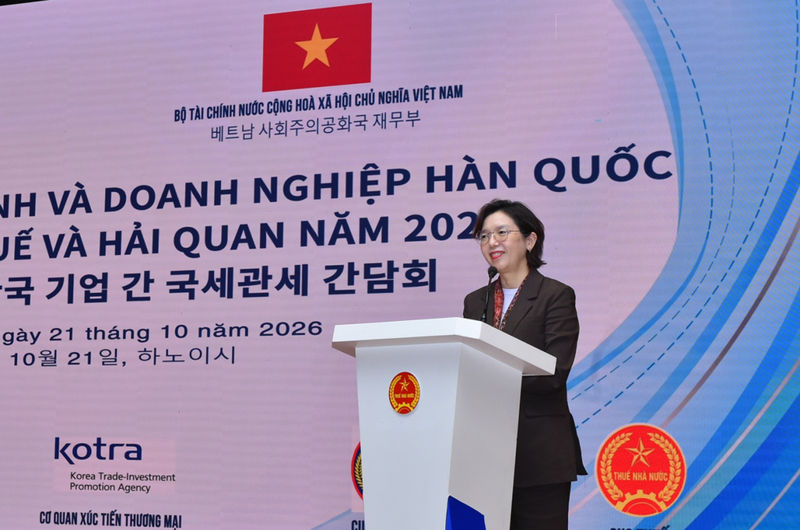
【Hanoi, Vietnam—Correspondent Kim Joon-seok】The Korean Embassy in Vietnam, the Korea Trade-Investment Promotion Agency (KOTRA), the Korean Chamber of Commerce in Vietnam (KOCHAM Vietnam), and Vietnam’s Ministry of Finance jointly held a tax and customs meeting, creating a forum for policy dialogue on local tax and customs challenges faced by Korean businesses operating in Vietnam and ways to improve the system.
According to local sources on the 22nd, around 100 people attended the meeting, including Lee Mi-yeon, South Korea’s ambassador to Vietnam, Vice Minister of Finance Cao Anh Tuan, officials from Vietnam’s Ministry of Finance and tax and customs authorities, and representatives of Korean businesses investing in Vietnam.
The meeting has been held annually since 2008 and is a key public-private dialogue channel where Korean businesses and Vietnamese government authorities directly discuss difficulties arising in the implementation of tax and customs policies. This year, ahead of the main event, Vietnam’s tax and customs authorities also ran an online Q&A program. It recorded about 40,000 views, and about 100 key questions submitted by Korean businesses were reviewed and responses prepared in advance.
In her opening remarks, Ambassador Lee Mi-yeon emphasized, “Korea ranks first in cumulative investment in Vietnam, second in official development assistance (ODA), and is one of Vietnam’s three largest trading partners.” She added, “In particular, this year Korean investment in Vietnam has risen sharply to about 160% of the level in the same period last year.” She also said, “This event is an important channel for communication where government authorities and businesses can share policy directions, discuss on-the-ground challenges candidly, and seek effective solutions.”
Vice Minister of Finance Cao Anh Tuan said, “The tax authority has achieved its goal of reducing the time and cost of administrative procedures by at least 50%.” He explained, “The customs authority has also simplified 11 administrative procedures, abolished 21 procedures, and reduced 14 business conditions and two conditionally permitted business sectors.” He added that administrative reforms using information technology were continuing, including modernizing electronic services in taxation and expanding support channels for taxpayers, as well as piloting an artificial intelligence (AI) chatbot and introducing a focused customs clearance model. Vice Minister Tuan emphasized that Vietnam’s Ministry of Finance would continue to improve its systems and policies, simplify administrative procedures, and support the prompt handling of businesses’ proposals.
Korean businesses attending the meeting formally proposed that Vietnamese authorities ensure clarity and consistency in investment incentive policies; protect intellectual property rights and promote technology transfer; expedite value-added tax (VAT) refunds; and ensure consistency in customs valuation, commodity classification codes, and the application of tax laws. Since these factors directly affect compliance costs, processing times, and businesses’ ability to plan their operations, they called for transparent and predictable administration.
[email protected] Kim Joon-seok Reporter