“Does a stroke always mean surgery?”... What determines the treatment? [Health Talk]
- Input
- 2026-10-22 10:58:18
- Updated
- 2026-10-22 10:58:18

[Financial News] Even when the type of stroke is the same, treatment can vary widely. Mild symptoms can be managed with medication, but if a major blood vessel is blocked or bleeding causes intracranial pressure to soar, doctors may need to go inside the blood vessel to remove a clot or open the skull.
The number of stroke patients in South Korea continues to rise. According to the Health Insurance Review and Assessment Service, the number of patients treated for ischemic stroke increased 7.5%, from 484,443 in 2018 to 520,895 in 2022. Over the same period, the number of patients with hemorrhagic stroke also rose 4.8%, from 97,420 to 102,127.
The chances of recovery from a stroke drop significantly if treatment is delayed. Yet according to the Korean Stroke Society’s Stroke Fact Sheet 2024, only 26.2% of ischemic stroke patients in 2022 arrived at a hospital within 3.5 hours of symptom onset.
Once patients arrive at the hospital, doctors determine the treatment by considering the type of stroke, the size of the affected area, the symptoms, and the risk of brain damage. This is because the extent of the affected area visible on imaging tests such as CT and MRI does not always correspond to the symptoms. Medical teams assess the images and symptoms together and select the appropriate treatment, from medication to endovascular treatment and craniotomy.
If a major blood vessel is blocked, the clot can be removed directly... treatment possible up to 24 hours later
Ischemic stroke occurs when a blood clot or another obstruction blocks a blood vessel in the brain, preventing an adequate supply of blood to brain tissue. The key to treatment is to reopen the blocked vessel quickly and restore blood flow. If a patient who arrives at the hospital within a certain period after symptoms begin meets the criteria, a clot-dissolving drug is administered intravenously.
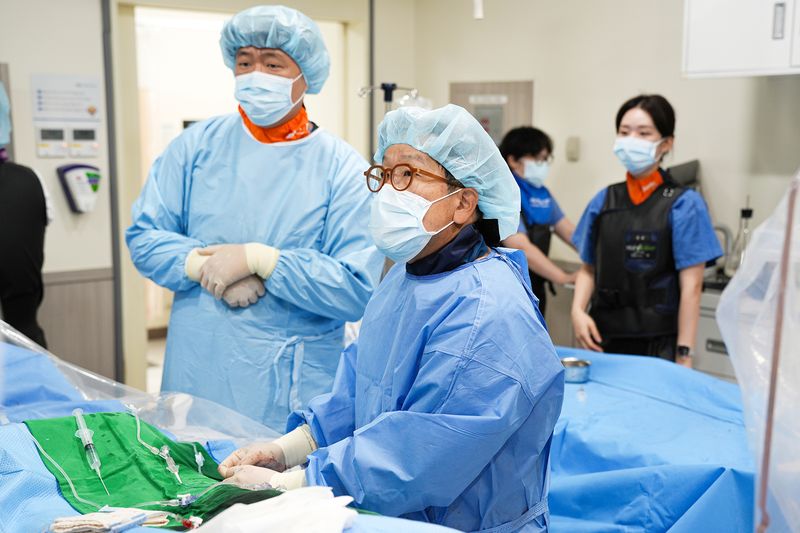
When a major blood vessel in the brain is blocked, clot-dissolving medication alone may not restore blood flow sufficiently, so doctors perform an “endovascular thrombectomy.” A catheter is inserted through the femoral artery in the groin and guided to the blocked brain vessel, where a stent retriever or aspiration device is used to remove the clot directly. The procedure restores blood flow through the blocked vessel in about 90% of cases.
The criteria for selecting patients for treatment have also changed. In the past, the main criterion was how much time had passed since symptoms began. More recently, CT or MRI has been used to assess whether brain tissue that can still recover remains. As a result, some patients can undergo thrombectomy up to 24 hours after symptom onset. However, this does not apply to every patient; the decision is made after considering the location of the blockage, the extent of brain damage, and the patient’s condition.
Even after acute treatment, if the blood vessels in the brain or the carotid artery are severely narrowed and the risk of recurrence is high, doctors may consider stenting or bypass surgery, depending on the cause and the condition of the blood vessels.
Surgery for hemorrhagic stroke depends on bleeding volume and consciousness... preventing rebleeding is key when an aneurysm ruptures
Hemorrhagic stroke occurs when a blood vessel in the brain ruptures and blood collects in the brain tissue. The bleeding itself can damage the brain, and the accumulated blood can also press on surrounding tissue, raise intracranial pressure, and cause further damage. Emergency surgery may be needed if there is substantial bleeding, the patient’s level of consciousness declines, or intracranial pressure rises sharply. In such cases, doctors perform a craniotomy to remove the accumulated blood, known as hematoma evacuation, or decompressive surgery to reduce intracranial pressure. Whether surgery is needed and which procedure to use are determined by considering the size and location of the bleed and the patient’s level of consciousness and neurological condition.
If a cerebral aneurysm ruptures, it can cause a “subarachnoid hemorrhage,” in which blood collects in the space beneath the arachnoid membrane surrounding the brain. A ruptured aneurysm must be treated as soon as possible because it can bleed again. Depending on the aneurysm’s location, size, shape, and the patient’s condition, doctors may perform clip ligation, using a craniotomy to clip the aneurysm’s opening directly, or coil embolization, in which they access the aneurysm through a blood vessel and block it from within.
Not every asymptomatic, unruptured cerebral aneurysm needs treatment. Clip ligation or endovascular treatment may be considered when the risk of rupture is judged to be high, based on the aneurysm’s size, location, and shape, as well as the patient’s age and risk factors.
During surgery, doctors use techniques such as evoked-potential monitoring, intracranial ultrasound, and indocyanine green (ICG) video angiography, which checks blood flow in real time, to protect healthy blood vessels and nerve function.
Professor Shin Hee-seop of the Department of Neurosurgery at Kyung Hee University Hospital at Gangdong explained, “The results of imaging tests do not necessarily correspond to the patient’s actual symptoms,” adding, “We determine the appropriate treatment by considering the test results and the patient’s condition together.”
Preventing recurrence is important after treatment. Chronic conditions such as high blood pressure, diabetes, and high cholesterol should be managed consistently, and lifestyle habits should be improved, including quitting smoking and reducing alcohol consumption. Patients should not stop taking or change prescribed antiplatelet or anticoagulant medication on their own without consulting their medical team.
Professor Shin emphasized, “Because prompt treatment has a major impact on the prognosis of a stroke, anyone who develops suspected symptoms such as sudden paralysis or speech problems should go to a hospital immediately,” adding, “Continued care to prevent recurrence remains important after treatment.”
Kyung Hee University Hospital at Gangdong also operates the “Stroke Patient Priority Care Track (BEST),” which prioritizes examinations, imaging, and transfer when a stroke patient arrives at the emergency room. Emergency medicine, neurosurgery, neurology, and radiology teams work together from the emergency-room stage, and the hospital is equipped with operating rooms dedicated to emergency surgery and intensive care units, enabling it to respond quickly to cases ranging from thrombectomy to emergency surgery.
[email protected] Jung Myung-jin, Medical Writer Reporter