BOK holds base rate at 3.0%, flashes strong tightening signal while taking a 'breather'
- Input
- 2026-10-22 10:34:20
- Updated
- 2026-10-22 10:34:20
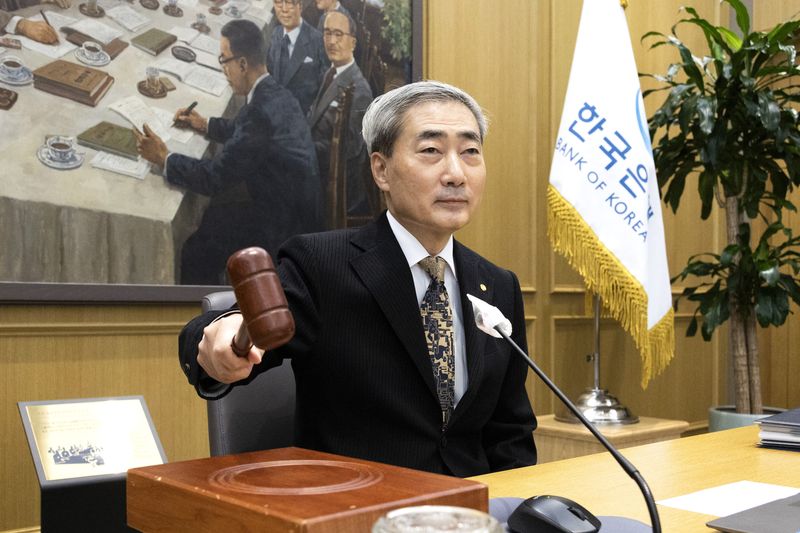
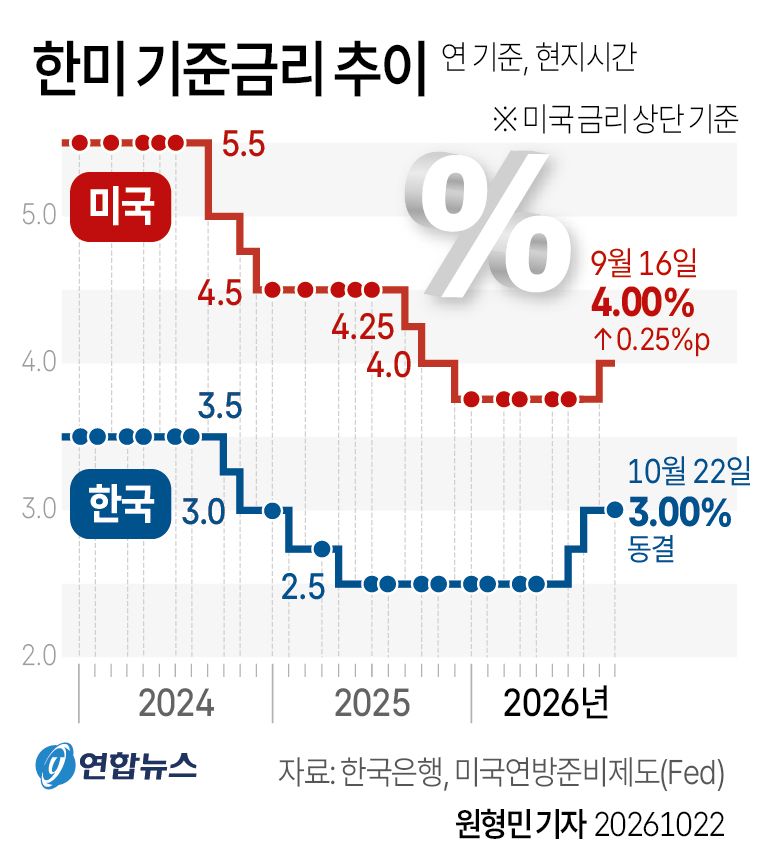
[Financial News] The Monetary Policy Board of the Bank of Korea (BOK) held a meeting on the 22nd to determine the direction of monetary policy and kept the base rate unchanged at its current annual rate of 3.00%. With financial imbalances—including consumer-price inflation, rising housing prices in the Capital Metropolitan Area and growing household debt—still present, the BOK is maintaining a strong tightening stance. However, as markets expected, it is seen as having opted for a strategic 'breather' this month to assess the cumulative effects of rate hikes and developments in the real economy.
The BOK previously raised the base rate by 0.25 percentage points each in July and August, two consecutive hikes that brought it to 3.0%.
The BOK said that all seven Monetary Policy Board members voted in favor of keeping the base rate unchanged.
The decision to hold the base rate can be seen as an effort by the BOK to assess the effects of its tightening and adjust the pace.
It cannot ignore the backlash of deepening polarization as it tries to rein in inflation.
In effect, it temporarily hit the brakes with concerns in mind about 'K-shaped polarization,' in which the shock of interest costs is concentrated in vulnerable sectors such as young people, small business owners, households that have borrowed to the hilt and marginal firms.
According to the BOK's analysis, the interest burdens on households and businesses become apparent at least five months after a base-rate hike, and a 0.25-percentage-point increase adds nearly 7 trillion won to their interest burden.
Growth in household loans also appears to have eased somewhat in September. Amid strict lending rules and other measures, the increase in household loans fell to around 600 billion won in September, from the previous month, when it had reached the 3 trillion won range. However, it is difficult to view this as a sustained decline in household loans, partly because fewer homes are becoming available for occupancy.
Nevertheless, the BOK's tightening stance is expected to become even firmer.
Inflation may appear relatively stable, but it faces considerable upward pressure. Since the start of the year, consumer prices have remained elevated, ranging from the upper 2% range to the low-to-mid 3% range, amid surging international oil prices due to the Middle East war and a rising exchange rate. Inflation has already exceeded the BOK's target of 2%. Going forward, upward pressure on prices continues to build as tensions in the Middle East intensify and demand rises on the back of strength in semiconductors.
At a CNN panel discussion on the 14th, BOK Governor Hyun Song Shin referred to 'the situation in Korea, where prices are rising as the two trends of an artificial intelligence (AI) investment boom and the Middle East war intersect,' and said, "I will stabilize prices as upward pressure mounts."
Strong economic growth so far this year is fueling inflation and demand. At a parliamentary audit on the 12th, Governor Shin also pointed to the sharp rise in nominal gross domestic product (GDP) in the second quarter of this year and said, "We will see inflation driven by demand-side factors."
Indeed, the cumulative current-account surplus from January through August this year was $279.2 billion, nearly four times the $69.67 billion recorded during the same period last year.
Stronger-than-expected semiconductor exports have raised the likelihood that this year's economic growth rate will exceed the BOK's August forecast of 3.3%.
The BOK stresses that it took policy action by proactively raising interest rates in two consecutive moves in July and August this year, helping to ease inflationary pressures and stabilize the exchange rate. It is expected to take a breather for now, assess the effects of the rate hikes and continue its tightening stance going forward.
Commercial banks generally expect two more rate hikes of 0.25 percentage points each, one in November and another early next year. The Monetary Policy Board's final monetary policy meeting of the year will be held in November.
Whether the Federal Open Market Committee (FOMC) of the U.S. Federal Reserve System (FRS) decides on further tightening at its meeting on the 27th and 28th is expected to be a key gauge for monetary policy.
[email protected] Jeong Sang-gyun Reporter