“Tampering with an electronic ankle monitor triggers an automatic spray of a tracking substance” ... Grand Prize in Science Policing Ideas Contest
- Input
- 2026-10-22 15:00:00
- Updated
- 2026-10-22 15:00:00
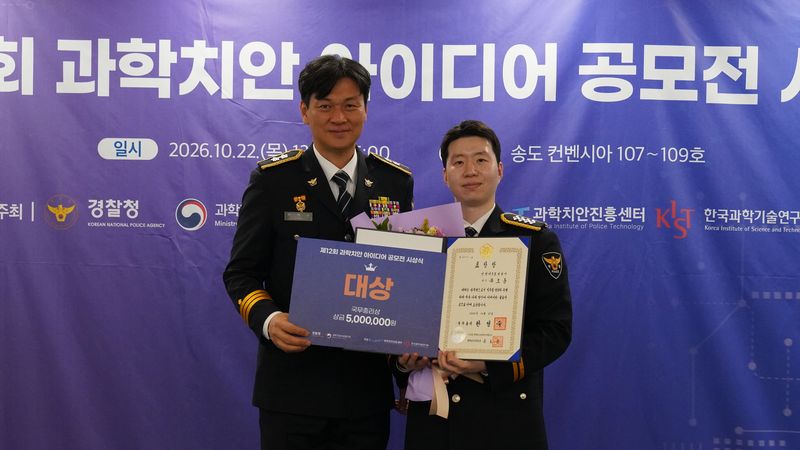
[Financial News] A technology that automatically sprays a special substance to track the escape route of stalking offenders and others when they tamper with an electronic tracking device (electronic ankle monitor) won the grand prize at the Science Policing Ideas Contest.
According to the National Police Agency, the awards ceremony for the 12th Science Policing Ideas Contest, co-hosted by the National Police Agency and the Ministry of Science and ICT, was held that day at Songdo Convensia in Incheon. A total of 474 ideas were submitted to this year’s contest, and 13 were selected as winning entries after judging.
The grand prize, which carries the Prime Minister’s Award, went to the “Digital Chemical Marker Automatic Spraying and Tracking System,” proposed by Sergeant Yu Jo-dong of Michuhol Police Station, Incheon Metropolitan Police Agency.
The technology automatically sprays a special marker substance that can be identified through ultraviolet (UV) light and olfactory response when stalking offenders and others tamper with their electronic ankle monitors. The idea is intended to address the difficulty of tracking offenders’ movements after an ankle monitor has been damaged. The grand prize winner received 5 million won.
The top award in the Police Category went to the “Smart Forensic Safety Goggles,” proposed by Sergeant Kim Jeong-hun of the Scientific Investigation Division at the Seoul Metropolitan Police Agency. The device combines the multi-wavelength light-emitting diode (LED) light source and filters used in crime-scene investigations with goggles, protecting forensic investigators’ eyes while improving the efficiency and accuracy of evidence searches.
The top award in the Public Category went to the “Bulletproof Protective Robot for Urban Counterterrorism Operations,” proposed by a team comprising Park Jun-hyeong, Choi Seong-uk, Kim Jun-hyeong, and Jeong Seong-hun. Its features include a bulletproof shield mounted on a tracked mobility platform, combined with semi-autonomous tracking navigation using LiDAR and remote-control functions. The robot is intended to reduce the burden on police officers of operating equipment and help ensure their safety during dangerous operations. Each top-award recipient received 3.5 million won.
Winning entries also included ideas for preventing stalking crimes and improving patrol efficiency. Selected proposals included a device that analyzes the signal strength, transmission intervals, and movement patterns of hidden Bluetooth, LTE, and 5G tracking devices to warn of stalking risks, as well as technology that uses artificial intelligence (AI) to recommend coordinated encirclement positions for multiple patrol cars.
Other ideas that received high marks included technology that uses AI to design optimal patrol routes and visualize patrol blind spots on a map, technology for quickly detecting latent fingerprints on wet evidence, and a system for assessing emergency risks among people subject to protective measures.
Since 2015, the National Police Agency and the Ministry of Science and ICT have held the Science Policing Ideas Contest annually for members of the public and police officers. This year, proposals were accepted from June 15 to July 24, and the winners were chosen after two rounds of judging, preliminary and final. A total of 19.8 million won in prize money was awarded to 13 teams.
Ideas developed through the contest over the years have led to research and development, including technology for precisely locating people requesting rescue, “Visible 112,” which transmits callers’ video and location, and a smartphone fingerprint identification system.
Hyunsoo Park, director of the National Police Agency’s Future Policing Policy Bureau, said, “Through this contest, we were able to see the interest and expectations surrounding science policing among the public and those working on the front lines of policing.” He stressed, “Going forward, we will work to put outstanding proposals, including the winning entries, to use in solving problems in the field through research and development.”
[email protected] Kim Ye-ji Reporter