Use of Domestic Timber: Public Sector Takes the Lead as Amended National Forests Act Takes Effect
- Input
- 2026-10-22 10:13:22
- Updated
- 2026-10-22 10:13:22
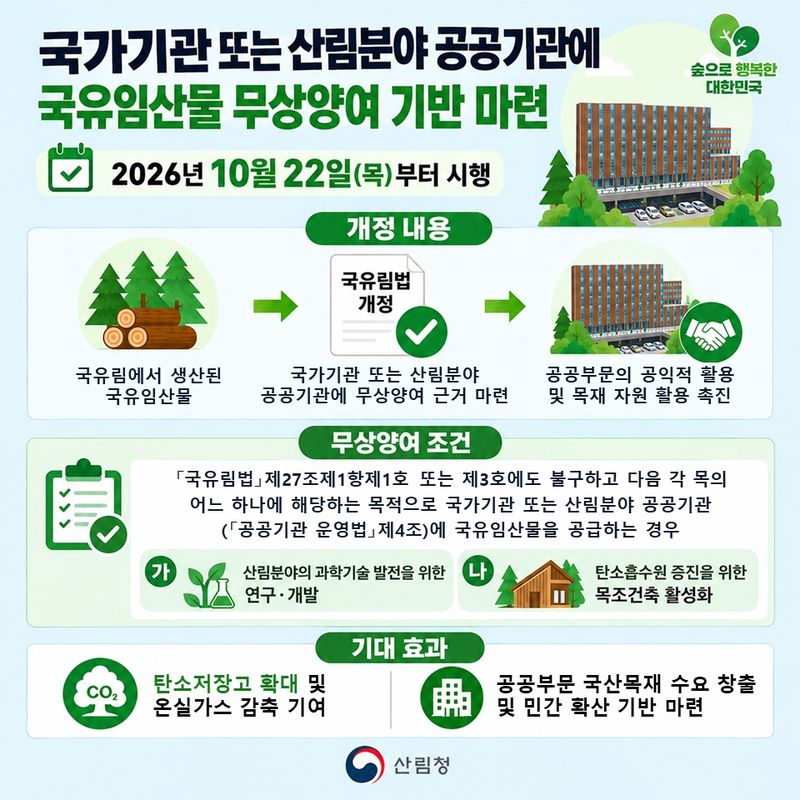
The Korea Forest Service (KFS) said the amended Act on the Management and Administration of National Forests (National Forests Act), revised to expand the use of domestic timber and establish an institutional foundation for fostering the timber industry, will take effect on the 22nd.
The legal amendment was pursued as part of the forest sector’s implementation strategy for achieving the National Greenhouse Gas Reduction Target (NDC) and 2050 carbon neutrality. To promote the use of domestic timber, which has strong carbon-storage capacity, the law was amended in April and takes full effect today.
Under the amended law, government agencies and public institutions in the forestry sector will be able to receive, free of charge, domestic timber produced in national forests and use it for wood-construction R&D, demonstration projects, and related work. The public sector is expected to lead the way in consuming domestic timber and serve as a catalyst for the development of related industries.
Korea Forest Service Commissioner Park Eun-sik said, "We will lead the way by expanding the use of domestic timber, starting with the public sector, and drive demand for it," adding, "We will spare no effort in providing support so that we can contribute not only to the development of the timber industry but also to achieving the national greenhouse gas reduction target."
Wood is considered a leading environmentally friendly carbon sink because it keeps carbon dioxide absorbed as it grows stored inside it for a long time. Replacing conventional building materials such as concrete and reinforcing steel with wood can greatly reduce emissions generated during manufacturing, making wood a key tool in achieving global carbon neutrality. However, South Korea’s timber self-sufficiency rate remains in the 10% range. Proactive demand creation by the public sector, centered on national forests, is expected to lay the groundwork for raising the self-sufficiency rate for domestic timber and establishing sustainable, cyclical forest management.
[email protected] Kim Won-jun Reporter