Pay Rises, Smartphones in Hand: Service Members Get Training to Prevent “Crypto Investment Scams” [Crypto Briefing]
- Input
- 2026-10-22 09:36:15
- Updated
- 2026-10-22 09:36:15
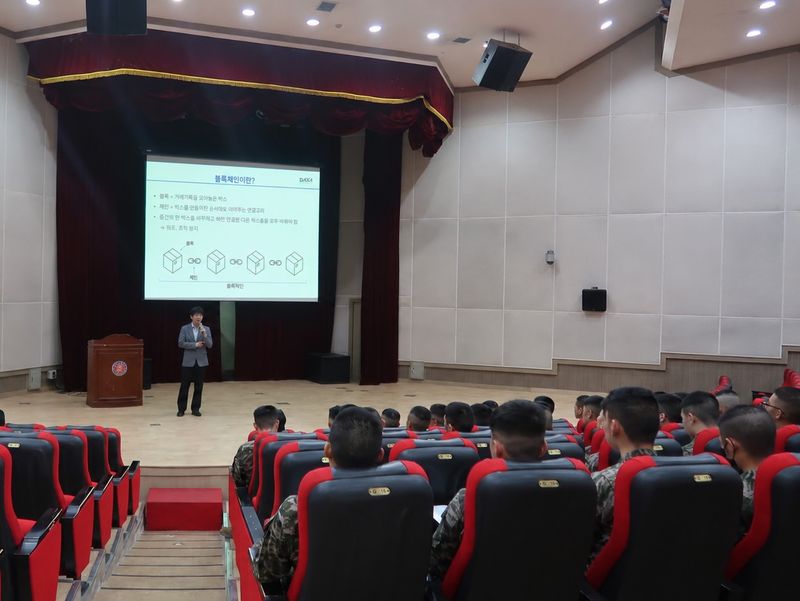
[Financial News] As soldiers’ pay rises and smartphone use after duty is permitted, service members are increasingly exposed to financial risks. According to the Credit Counseling and Recovery Service (CCRS), around 1,000 people serving in the military apply for debt adjustment each year, carrying average debts in the 50-million-won range. Cases have also been identified in which people who suffered losses in virtual-asset investments turned to online gambling to recoup them. Against this backdrop, the virtual-asset industry has gone directly to military bases this time. On the 22nd, the industry said that Digital Asset eXchange Alliance (DAXA) held training on preventing financial investment scams linked to virtual assets for around 100 Republic of Korea Marine Corps service members at ROK Marine Corps Headquarters on the 13th.
This was the third DAXA tailored training session for military personnel, following sessions in August 2024 for the Military Police Group of the Capital Defense Command and in December of the same year for subordinate units of the Capital Defense Command.
Recent changes in service conditions, including pay increases for service members and expanded access to mobile phones during military service, have made it easier for young service members to access financial investments. At the same time, the need for awareness and preventive education about financial investment scams exploiting virtual assets—including illegal investment tip chatrooms, impersonation scams, and romance scams—has grown. DAXA organized the training to help young service members develop sound investment judgment based on a proper understanding of virtual assets and avoid falling victim to financial investment scams.
The session was led by DAXA advisory committee member Jae-woo Cho. He explained the basic concepts of blockchain and virtual assets, major types of financial investment scams linked to virtual assets, real-life cases, and sound investment practices. Particular emphasis was placed on examining risks service members may encounter while investing, identifying suspicious investment solicitations, and providing practical steps to prevent losses.
As part of the intensive financial education for older adults being jointly conducted by the Financial Supervisory Service (FSS) and the financial sector over two months from October to November, DAXA will also stage a traditional Korean outdoor theater performance to prevent financial investment scams linked to virtual assets.
DAXA Executive Vice Chairman Jae-jin Kim said, “As young service members’ participation in virtual-asset investment grows, preventive education that takes their investment habits and service conditions into account is essential. We will continue to expand tailored education that considers the needs of different groups, and work to foster a sound environment for virtual-asset use and protect users.”
DAXA is expanding its education program beyond young service members to include older adults. The FSS will conduct 687 intensive financial education sessions for older adults nationwide over two months in October and November, together with 17 banks, the Financial Investment Association, and DAXA. DAXA is responsible for education on preventing investment scams involving virtual assets, and a program has also been prepared to share cases of financial scam losses and ways to avoid them through plays and traditional outdoor theater. DAXA previously staged “Outdoor Theater to Prevent Financial Scams Linked to Virtual Assets” in Busan in August, and on September 14 released an educational video titled “Beware of Impersonation of KRW Exchange PC Apps.”
[email protected] Young-jun Han Reporter