70% of Hyundai Motor employees use AI; 10,000 GPUs to be deployed by 2029
- Input
- 2026-10-22 08:55:23
- Updated
- 2026-10-22 08:55:23
[Financial News] At least seven in 10 Hyundai Motor Group employees use generative artificial intelligence (AI) for work, it has emerged. The group is expanding the use of AI across sales, maintenance and production, drawing on vast amounts of data collected from 12 million connected cars worldwide. It plans to strengthen its capabilities in physical AI, including autonomous driving and robotics, by securing infrastructure with at least 10,000 graphics processing units (GPUs) by 2029.
■ 70% of employees use AI; 140 PB of vehicle data secured
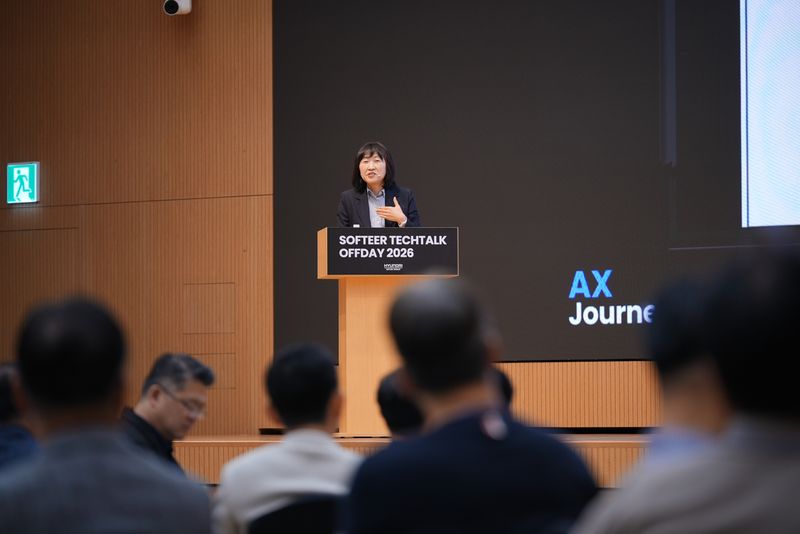
Hyundai Motor Group said on the 22nd that it had held “Softeer Tech Talk Off Day 2026” at its headquarters in Yangjae-dong, Seoul, on the 21st for IT leaders from domestic companies and members of the media, and shared its achievements in AI transformation (AX) and future strategy. This was the first time the group had opened to the public an in-house technology conference it has run since 2023.In her keynote address, Eunsook Jin, president in charge of ICT at Hyundai Motor Group, said, “AX is not completed by adopting a single technology; it is a process of continually searching for answers. The challenges Hyundai Motor Group has faced are similar to those confronting any company pursuing AX, so we will share our experiences, listen to others’ views and work together to find solutions.”
Before adopting AI, Hyundai Motor Group had pursued digital transformation (DX), including integrating data and establishing a cloud-based collaborative environment. As a result, it secured about 140 petabytes (PB) of vehicle sensor data collected in real time from around 12 million connected cars worldwide. Customer, quality and sales data from dozens of affiliates are also integrated and managed through at least 7,000 data pipelines.
The in-house generative AI platform “H Chat,” introduced in 2023 on the strength of this data infrastructure, is now used by at least 70% of the group’s employees. Since July, the group has established a system that complies with government security standards and expanded the platform’s use to fields involving nationally strategic technologies, including autonomous driving and hydrogen.
■ AI deployed in 73 production processes; GPU infrastructure to expand
AI is spreading to real-world production, sales and maintenance operations. Hyundai Motor Group consolidated into a single model the vehicle identification number (VIN) recognition AI systems that had been operated separately at each plant, and deployed it in 73 processes at home and abroad. The system detects errors in vehicle assembly sequences and reduces the burden of developing and managing a separate AI model for each plant.In sales, AI has been set up to first propose vehicle demand plans, while in maintenance, it provides inspection information based on official service manuals. The group also integrated work-related information that had been scattered across departments, cutting the time needed to search internal information from about 10 minutes to around 20 seconds.
Park Geun-han, managing director of Hyundai Motor Group’s Machine Learning Lab, emphasized, “What determined the success or failure of AI projects was not the AI technology itself, but clear problem definitions that reflect issues in the field, a shared platform, and a sustainable data management system led by the departments doing the work. The systems we have built by addressing operational constraints one by one will become a competitive advantage that others cannot easily replicate.”
Hyundai Motor Group is also building a platform to extend AI use across the entire company. This month, it will launch “H-Launch,” which will allow employees to distribute AI work tools they have developed themselves within the company. The group also plans to assign unique identification numbers to AI agents to track their activity and require human approval for important operations such as deleting data.
The group is also expanding its large-scale AI computing infrastructure. It will build up GPU-based service capacity in stages starting in the fourth quarter of this year, and aims to operate services using at least 10,000 GPUs at the Saemangeum AI Data Center in the second half of 2029. The plan is to provide organizations across the group with the computing resources needed to develop physical AI, including autonomous driving and robotics.
Jin said, “Whatever technology emerges, the most important thing is an organizational culture that quickly puts it to use and turns it into business results. We will build an organization that learns quickly, forgets quickly and learns again, so we can stay ahead in responding to the next technological innovation.”
Meanwhile, Hyundai Motor Group will hold 12 sessions for group employees today, covering AX-enabling technologies such as data and cloud, as well as examples of AI applications in production, logistics and security.
[email protected] Kim Dong-ho Reporter