Five accidents in Seoul recast as a complex disaster; 725 people join joint drill
- Input
- 2026-10-22 10:00:00
- Updated
- 2026-10-22 10:00:00
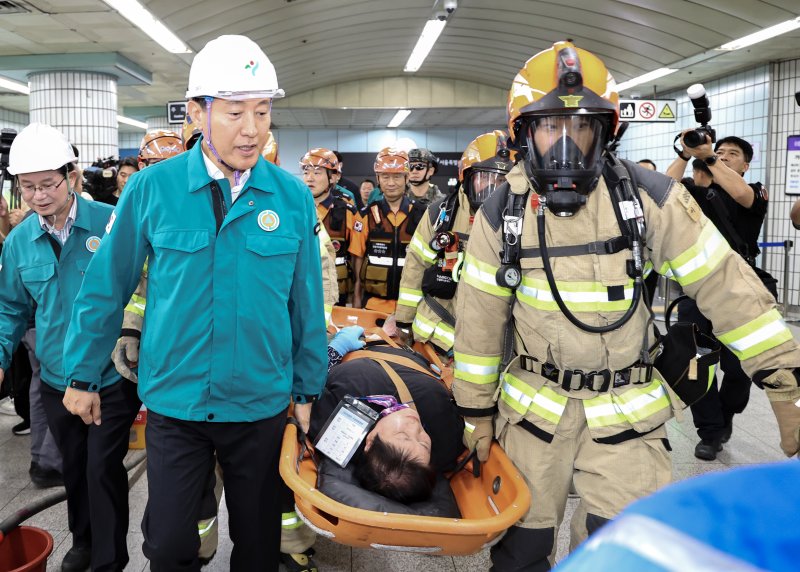
[Financial News] The Seoul Metropolitan Government held a large-scale joint exercise to prepare for multiple disasters occurring simultaneously, including ground subsidence, structural collapses and electric vehicle fires. It reconstructed five accidents that had actually occurred in Seoul recently as a complex disaster scenario and comprehensively tested the response system of relevant agencies, from lifesaving and emergency medical care to the restoration of essential infrastructure. The Seoul Metropolitan Government said it held the “2026 Seoul Disaster Response Safe Korea Exercise” on the 22nd at Mokdong Sports Complex in Yangcheon-gu, with Seoul Mayor Oh Se-hoon in attendance. A total of 725 people from 21 institutions and organizations, including the Seoul Metropolitan Government, Yangcheon-gu, fire services, police, the military and Korea Electric Power Corporation, took part, and 76 vehicles were deployed.
The exercise was based on five accidents that had occurred recently in Seoul: ground subsidence in Myeongil-dong, an accident at the Seosomun Overpass demolition site, an electric bus fire at an Eunpyeong bus depot, a guesthouse fire in Sogong-dong and an underground utility tunnel fire in Seongbuk-gu. Rather than focusing only on responses to individual disasters, the exercise centered on checking whether on-site command, rescue and emergency medical response, and facility restoration could be coordinated effectively when several accidents occurred at once.
Five zones were set up at the exercise site according to the type of accident. In a scenario where the road had caved in and a vehicle had fallen into the hole, participants used ground-penetrating radar (GPR) to assess ground conditions before bringing in lifting equipment to rescue the occupants.
The scenario involving the collapse of a structure at a construction site featured search-and-rescue dogs, search drones and quadruped robots. The exercise also tested the process of locating and rescuing survivors in the rubble using advanced equipment, including radio-wave detectors.
The electric vehicle fire-response exercise simulated flames spreading due to battery thermal runaway. Participants tested firefighting procedures by using fire-suppression blankets to contain the spread of the flames and portable water tanks to cool the batteries.
An exercise was also held to prepare for a situation involving a large number of foreign victims. Rescue workers tested how to assess the condition of patients who have difficulty communicating in Korean and provide emergency medical care, using pictogram cards to convey information visually, AI translation apps and interpretation support.
The exercise also recreated a situation in which damaged communications facilities had disrupted card payments and telecommunications services. It focused on reducing inconvenience to residents and business losses for small merchants by providing temporary payment methods and urgently restoring communications networks.
Separately from the field exercise, a discussion-based exercise was held at Seoul City Hall to activate the Disaster and Safety Countermeasures Headquarters. The exercise reviewed the overall command structure, including how information about a disaster is relayed to relevant agencies and how 13 working groups are activated following a situation assessment meeting.
After chairing a situation assessment meeting at Mokdong Sports Complex, Mayor Oh toured each exercise zone to review the agencies’ responses and how advanced rescue equipment was being used.
Mayor Oh said, “This exercise is an opportunity to check whether the cooperation system among relevant agencies operates effectively in response to complex disasters, and to review the entire process—from initial disaster response through recovery and restoration—including support for victims beyond language and nationality and the restoration of everyday life. We will address the shortcomings identified during the exercise and incorporate the lessons into our actual disaster-response system to make Seoul a ‘special city for quality of life’ that safeguards residents’ lives and daily routines.”
[email protected] Seong Chorong Reporter