Merck to build molybdenum production facility in North Chungcheong, boosting supply of next-generation semiconductor materials
- Input
- 2026-10-22 09:00:00
- Updated
- 2026-10-22 09:00:00
[Financial News] German science and technology company Merck will build a molybdenum precursor production facility in Eumseong, North Chungcheong Province, and strengthen domestic supply of next-generation semiconductor materials. Its strategy is to link local production of materials with supply systems and technical support to meet the needs of Korean customers as they expand production and change their processes.
Hanyang Engineering will hold an opening ceremony for its molybdenum dioxide dichloride (MoO2Cl2) production facility at its Eumseong site on the 22nd. Benjamin Hein, who took office as CEO of Merck Electronics last May, made his first visit to Korea, and other senior executives, including Chief Technology Officer (CTO) Suresh Rajaraman, also came to the country.
Molybdenum is considered a next-generation material that can meet the demands of semiconductor miniaturization and the shift to memory with more layers. As memory stacks grow taller, technologies that reduce electrical resistance and form uniform films over complex surfaces are becoming more important.
During a Q&A session held the previous day, Merck representatives said molybdenum offers an advantage over existing tungsten processes in creating space for current to flow. They forecast that opportunities to use molybdenum would also expand as structures become smaller and effects such as surface scattering, which hinders electron movement, grow more significant.
They said its applications could expand from NAND to DRAM and logic devices in the future. However, they noted that adoption rates and the pace of expansion could vary by customer. They expect its use in backside power delivery structures to depend on the size of the structures and its advantages over existing materials.
The molybdenum produced at the new Eumseong facility is a specialty precursor used in chemical vapor deposition (CVD) and atomic layer deposition (ALD). Merck will combine it with its “CK VAPOR” supply system, which is produced at its Ansan site. According to the company, the solution is designed to support mass production through material utilization efficiency of at least 99% and a stable supply.
The point is that wider adoption of new materials requires not only performance validation but also a supply system aligned with customers’ mass-production schedules. Merck plans to link its material production capabilities in Eumseong with its supply system in Ansan and its global research and technology network to support customer material qualification and process changes. It did not disclose the new facility’s specific production capacity.
Merck also left open the possibility of further investment in Korea. The company said it was taking into account the potential for rapid growth in Korea’s semiconductor industry over the next four to five years, and was discussing preparations with customers to respond to a potential doubling of demand for semiconductor materials and solutions within five years. It said this would require expanding cooperation with domestic institutions and suppliers and speeding up responses for prototypes and small-volume production.
Merck said it already produces extreme ultraviolet (EUV) materials in Korea and has also invested in expanding production facilities. It plans to continue investing in the country in line with customers’ adoption of EUV equipment, the expansion of new fabs, and product uptake.
Advanced packaging was also identified as a major growth area. Merck representatives said addressing production capacity shortages is a short-term challenge, while materials and process innovation to meet the expansion of three-dimensional structures will be important over the medium to long term. The company plans to extend materials technologies developed in front-end processes to advanced packaging, while also strengthening metrology and inspection technologies for managing material quality and purity.
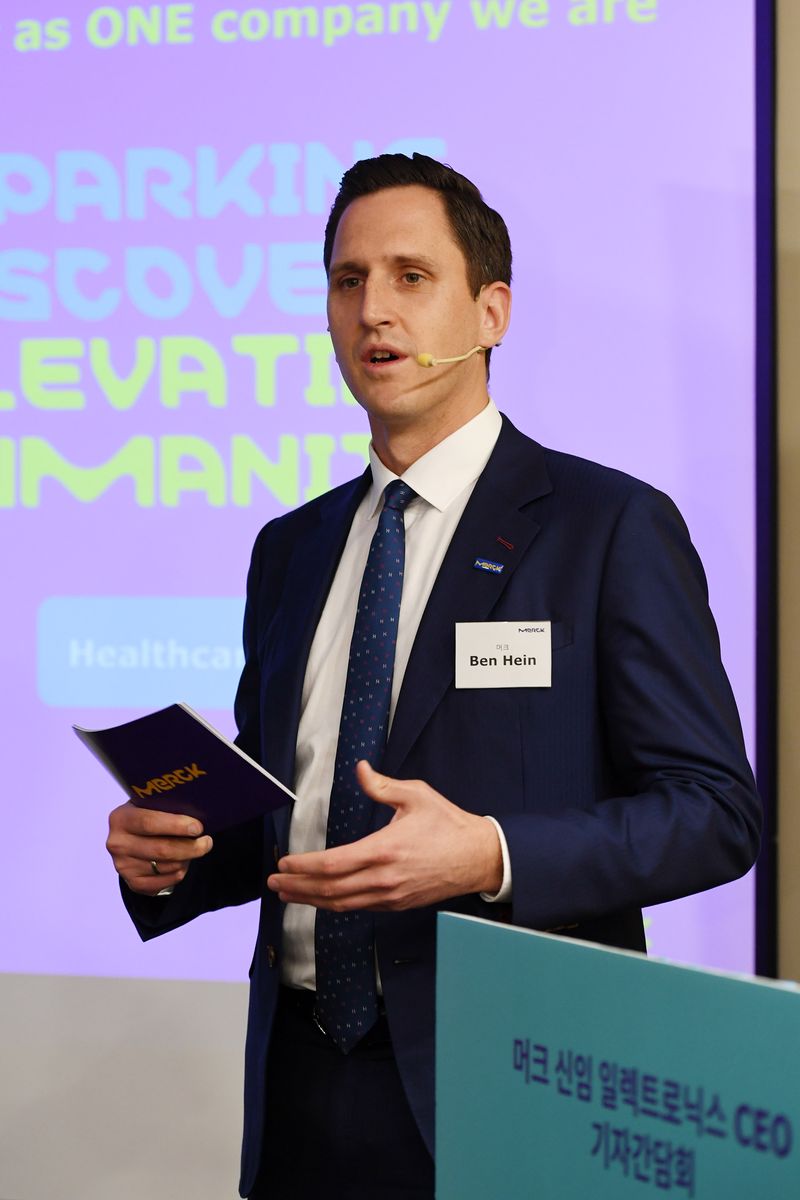
CEO Hein said, “AI is transforming the semiconductor industry, further increasing its complexity and accelerating the pace of innovation. It is difficult to sustain future growth through conventional approaches to miniaturization and advances in individual materials alone, so the next wave of innovation will be driven by system integration. That is why Merck provides integrated workflow solutions based on its strong materials expertise, and its molybdenum solution, which integrates chemical materials and supply systems, is a successful example of this approach.”
Merck had invested more than 220 million euros in Korea by 2020 and announced an additional investment worth 600 million euros in 2021. The related investment projects are now in their final stages. Established in 2015, the Eumseong site became part of Merck through its acquisition of M Chemical in 2023 and currently employs about 100 people.
[email protected] Park Ji-yeon Reporter