Constitutional Court partially grants Lee Jin-sook’s injunction against recusal from parliamentary audit; she may participate except in matters involving her
- Input
- 2026-10-21 19:53:13
- Updated
- 2026-10-21 19:53:13
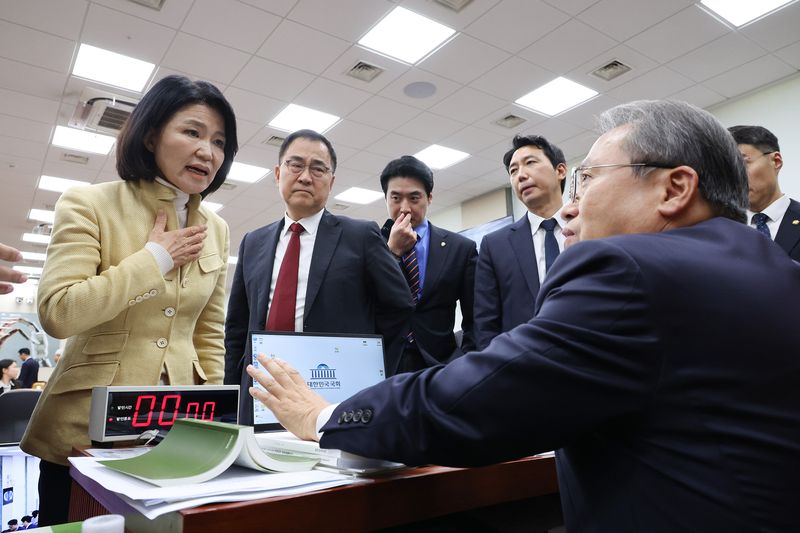
[Financial News] The Constitutional Court of Korea partially suspended the effect of the decision to recuse People Power Party lawmaker Lee Jin-sook from the National Assembly’s audit by the Science, ICT, Broadcasting, and Communications Committee. Lee may therefore participate in the audit on the 22nd, but her participation will be restricted on matters in which she has a direct personal interest.
On the 21st, the Constitutional Court of Korea partially granted Lee’s petition for an injunction suspending the decision’s effect, with all justices in agreement. The court said, “A recusal resolution may be adopted only with respect to a matter in which a lawmaker has a direct interest or there is an exceptional reason that makes it impossible to ensure fairness; an audit cannot be restricted across the board simply because grounds for recusal exist.”
However, the court found that matters Lee was involved in while serving as chair of the Korea Communications Commission, including decisions she participated in, as well as criminal cases involving her, could potentially be grounds for recusal.
Specifically, these include recommendations for KBS board members and appointments to the board of the Foundation for Broadcast Culture made under a two-member Korea Communications Commission, approval of the appointment of the EBS president, the case involving a complaint over alleged perjury during a parliamentary audit, and the case involving a complaint over alleged occupational breach of trust related to the use of a corporate credit card.
The Constitutional Court noted that “there may be grounds to find that a direct interest exists or that there is an exceptional reason making it impossible to ensure fairness.”
However, the Constitutional Court found that the grounds for recusal in the remaining matters were unclear, while a blanket restriction on Lee’s participation in the audit could make it difficult to remedy an infringement of her authority as a lawmaker afterward. It explained that concerns about conflicts of interest could be addressed through Lee’s voluntary recusal or the committee chair’s exercise of authority to maintain order.
The Constitutional Court ruled that “the harm that would result if the petition were dismissed after the injunction was granted would be less than the harm that would result if the petition were granted after the injunction was denied.”
The applications concerning the audits on the 12th and 16th, which had already concluded, were dismissed for lack of a legal interest in seeking relief. The application filed by the People Power Party was also dismissed because political parties are not recognized as having the capacity to be parties to adjudications of jurisdictional disputes.
Earlier, on the 12th, the Science, ICT, Broadcasting, and Communications Committee passed a motion to recuse Lee, saying that work she had handled while serving as chair of the Korea Communications Commission was included in the audit and could give rise to a conflict of interest. Lee and the People Power Party subsequently filed a petition for adjudication of a jurisdictional dispute and an application for an injunction suspending the decision’s effect on the 15th.
This is the Constitutional Court’s first ruling concerning a resolution to suspend an audit of a member of the National Assembly, and the 13th case in which it has granted an injunction since its establishment.
Adjudication of a jurisdictional dispute is a procedure for seeking a ruling from the Constitutional Court when a dispute over powers arises between state institutions under the Constitution. An injunction to suspend the effect of a measure, sought alongside such a petition, is granted only when it is necessary to prevent irreparable harm to the applicant institution or when a serious public-welfare consideration is recognized.
[email protected] Choi Eun-sol Reporter