Government policy drives a wedge between rice prices... Japan’s prices fell 43%, while Korea’s dropped 4%
- Input
- 2026-10-21 19:01:35
- Updated
- 2026-10-21 19:01:35
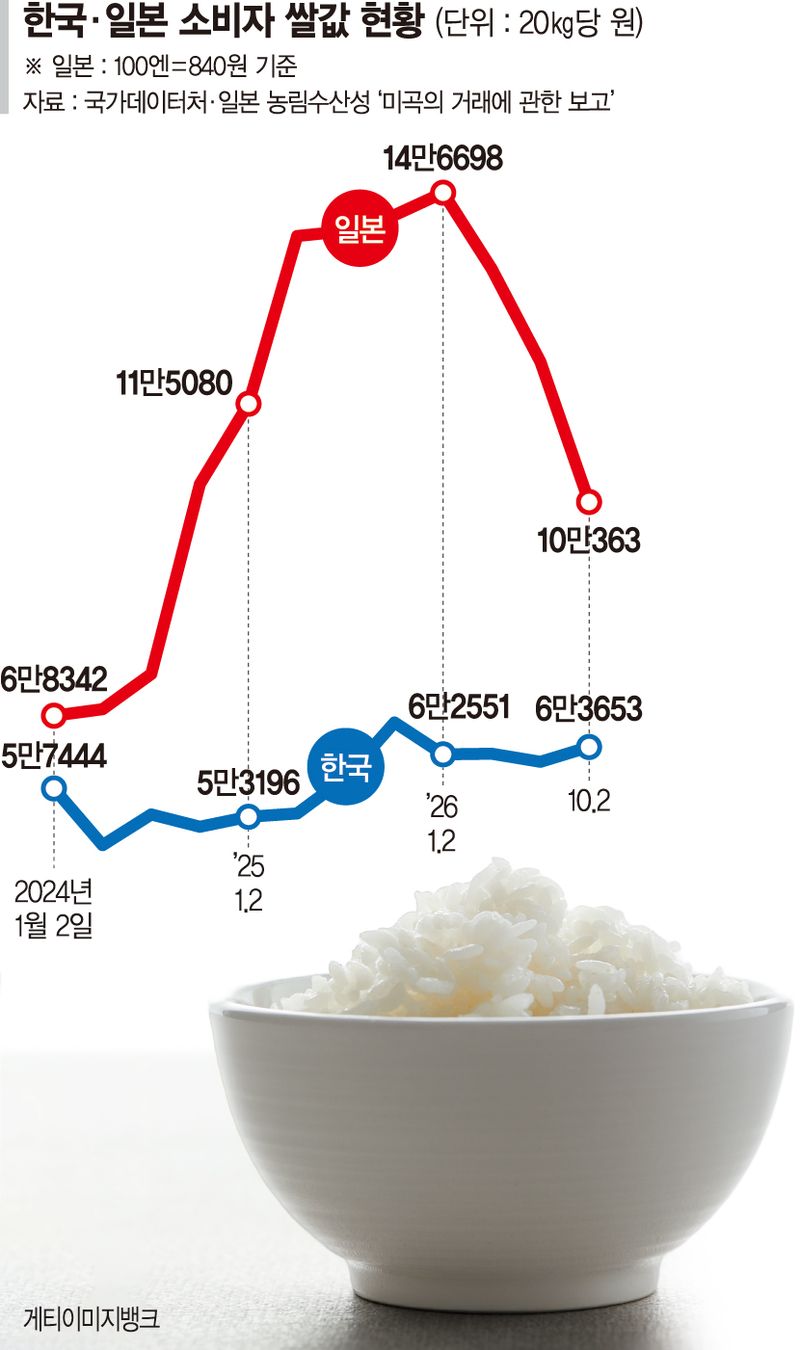
Experts say the importance of proactive measures to manage rice supply and demand will grow amid the climate crisis. However, they point to limitations: the stronger the government’s influence over rice prices, the greater the budget outlay, and the harder it becomes to structurally shift agriculture away from its reliance on rice.
According to the National Data Agency and Japan’s Ministry of Agriculture, Forestry and Fisheries on the 21st, farm-gate rice prices in Japan and Korea are moving in opposite directions. Japan’s 2025-crop rice was priced at 12,353 yen (about 103,765 won) in October. This figure is a simple conversion of 60 kg of Japanese brown rice to 20 kg. That was 55.6% higher than the 7,940 yen (about 66,696 won) recorded in the same month a year earlier and 151.8% above the typical-year average of 4,905 yen (about 41,202 won), respectively. By contrast, the price in September this year was 7,098 yen (59,620 won), down 43% from October last year. Rice prices typically fall after peaking during the October harvest season.
Korean farm-gate rice prices stood at 56,595 won in September this year, about 3,000 won less than in Japan. While prices in Japan fell 43% from their peak, those in Korea declined by just 4.4%. Korean farm-gate rice prices for the 2025 crop were 59,216 won in October, 27.8% higher than the 46,325 won recorded in the same month a year earlier and 16.3% above the typical-year average of 50,914 won.
The gap between the two countries’ “consumer rice prices” is wider than at the farm gate, at about 36,000 won. For 20 kg, the price in Japan was 11,820 yen (about 99,288 won) on the 13th of this month. In Korea, it was 63,513 won. A year earlier, the prices were 17,524 yen (about 147,107 won) in Japan and 66,972 won in Korea, meaning they fell by 32.6% and 5.2%, respectively. The declines were therefore markedly different.
Japan’s Ministry of Agriculture, Forestry and Fisheries cited reduced output due to extreme heat, increased household stockpiling amid fears of a major earthquake, and a rise in overseas visitors among the causes of the rice shortage that began in the summer of 2024. Last year, after rice prices surged despite releases from public stockpiles, Japanese farmers expanded their cultivation of rice for human consumption this year, and prices plunged. Even the preliminary payment this year fell by 38%, dropping below production costs. The preliminary payment is money that JA (Japan Agricultural Cooperatives) pays farmers upfront when purchasing their rice during the autumn harvest season. In effect, JA expects rice prices to fall next year and is paying farmers a smaller advance.
Japan initially pursued a policy of not intervening in the rice market through government stockpiles. This was because the accumulation of rice stocks in the late 1990s led to a problem: the annual burden of operating the stockpiles reached 150 billion yen. But the latest rice-market turmoil has fueled criticism of a supply-and-demand system that places emphasis on after-the-fact measures, such as buying rice for government reserves.
Korea, by contrast, is seeking to reduce rice-price volatility throughout the year through proactive supply-and-demand management. After prices rose during the off-season (July–September) last year, the government introduced a government rice loan program. This year, it also launched for the first time a “supply-adjustment paddy rice” program, which limits the rice’s use to processing and curbs advance production by managing the supply of rice for human consumption. In effect, the government lends out its rice stocks to moderate price increases and adjusts supply in advance through the program in preparation for a possible expansion in rice-growing acreage.
Experts noted that the supply-and-demand management function has become more important amid the climate crisis. Some argue that support rates under the strategic crop direct payment scheme, including for supply-adjustment paddy rice, need to be brought in line with current conditions for proactive rice policies to be implemented effectively. “Both countries are trying to change their rice-centered agricultural structures, but it’s difficult because of the convenience of farming and farmers’ incomes,” said Nam Jae-jak, head of the Korea Precision Agriculture Research Institute. “Going forward, we need to pay more attention to rice’s premium value and competitiveness in distribution.”
Meanwhile, the stronger the policies to support rice prices, the greater the “fiscal burden.” Next year’s government budget proposal for stabilizing rice supply and demand totals 841.3 billion won: 500.6 billion won for NongHyup loss compensation related to market-isolation measures, 337.8 billion won for the public-interest direct payment scheme (including the summer strategic crop direct payment scheme), and 2.9 billion won for the rice self-help fund. That is double the amount in 2023, five years earlier. The Ministry of Agriculture, Food and Rural Affairs stressed, “Proactive supply-and-demand management can reduce the cost of isolating rice from the market and thereby save money in the budget.”
[email protected] Choi Yong-jun, Agriculture Specialist Reporter