Value-up ETFs lose steam, down 18.5% this month
- Input
- 2026-10-21 18:16:21
- Updated
- 2026-10-21 18:16:21
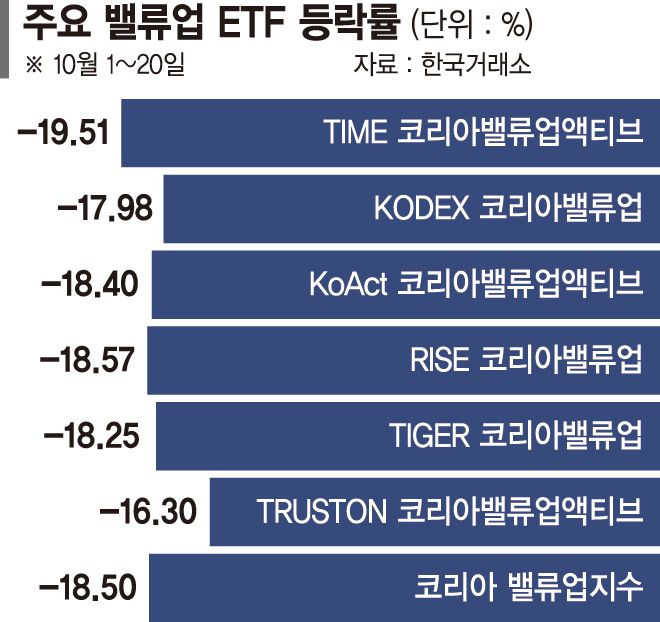
According to the Korea Exchange on the 21st, the average change in closing prices for the 13 value-up ETFs listed in Korea from the 1st through the 20th of this month was -18.48%. Individual products fell between 16.30% and 19.53%, with all recording double-digit declines.
The major passive product KODEX Korea Value-up fell 17.98%, while RISE Korea Value-up and TIGER Korea Value-up declined 18.57% and 18.25%, respectively. Over the same period, the Korea Value-up Index fell 18.50%, from 3,228.34 to 2,631.25.
The declines spread across the Value-up Index’s constituents. An analysis of the month-to-date changes in the 100 constituent stocks, as of the previous day, found that 71 had fallen and 29 had risen. Forty-three stocks had dropped by 10% or more, and 19 had fallen by at least 20%.
The Value-up Index has a relatively low exposure to semiconductors and a high weighting in banks, giving it a defensive profile. But the benefits of this composition were limited during a sharp selloff, when stocks across the board fell steeply. The assessment is that bank stocks also declined, making it difficult to avoid the shock.
Active ETFs also fell sharply. TIME Korea Value-up Active dropped 19.51%, falling 1.01 percentage points more than the Value-up Index. KoAct Korea Value-up Active declined 18.40%, in line with the index. TRUSTON Korea Value-up Active fell 16.30%, outperforming the index by 2.20 percentage points, but still posted a double-digit loss.
The asset management industry said active management does not necessarily provide downside protection. A strategy of holding stocks that are sensitive to market movements in pursuit of excess returns during a rising market can become an additional burden during a sharp selloff, it explained.
An asset management industry official explained, “Investors tend to remember products that delivered high returns in a rising market more than those that held up well in a downturn,” adding, “When a portfolio is structured so that an active product rises more in a bull market, its losses can be greater in a downturn.”
[email protected] Bae Hangeul Reporter