“Shortening the stock settlement cycle” delayed by a year ... Roadmap not finalized amid opposition from foreign firms
- Input
- 2026-10-21 18:16:17
- Updated
- 2026-10-21 18:16:17
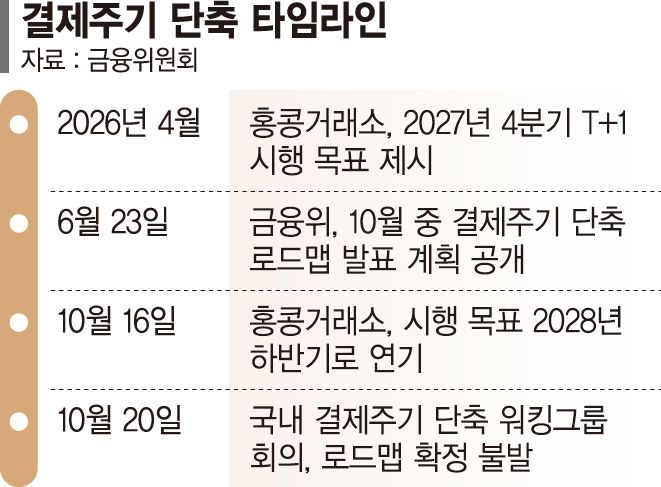
According to the financial investment industry on the 21st, the working group meeting on shortening the settlement cycle, held the previous day, failed to reach any significant conclusions on the roadmap, and no date was set for the next meeting. The working group, which includes the Financial Services Commission (FSC), the Korea Exchange, the Korea Securities Depository and the Korea Financial Investment Association, has been discussing a shorter settlement cycle since the end of last year.
The FSC had previously said in June that it planned to announce in October a roadmap for shortening the stock settlement cycle from the current “T+2 (two days later)” to “T+1 (one day later).” At a Cabinet meeting held that same month, President Lee Jae-myung also called for a shorter settlement cycle, saying, “From the perspective of stock market participants, it may be hard to understand why it takes as long as two days to receive the proceeds from selling stocks.”
However, an announcement this month, as originally planned, has become virtually impossible. The working group held a marathon meeting lasting several hours but failed to coordinate the detailed schedule. Above all, difficulty estimating how much preparation time the industry would need has proved a major obstacle. An estimated 600 or so financial institutions—including securities firms, institutions and funds—will be affected by the shorter settlement cycle. Their capabilities and circumstances vary, and preparations could take anywhere from six months to at least a year and a half, making it difficult to set a uniform schedule.
Opposition from foreign financial institutions was particularly strong. They have argued from the outset that they would need considerable preparation time, saying that currency conversion, time differences and regulations make their settlement procedures more complicated than those of domestic investors, increasing the burden of shortening the cycle.
The recent decision by Hong Kong Exchanges and Clearing (HKEX) to defer implementation of a shorter settlement cycle also became a factor. On the 16th local time, HKEX officially announced that it would postpone the change by about a year, from the original fourth quarter of 2027 to September 2028. Domestic authorities had also been drawing up a roadmap centered on implementation in the fourth quarter of 2027 to align with Hong Kong, but the explanation is that Hong Kong’s change of plans has caused a setback.
The working group, including the authorities, now sees the end of 2028 as the implementation date, in line with Hong Kong. This is because foreign financial institutions, which have strongly opposed the change, are calling for implementation to take place at around the same time as in Hong Kong. Capital markets are generally divided into regional blocs, and major differences in implementation dates among Asian countries would increase the burden of developing systems. The United States, for example, shortened its settlement cycle alongside Canada, Mexico and others, while around 30 European countries are pursuing the change jointly.
[email protected] Im Sang-hyeok Reporter