Air holes boost breathability and help transfer heat [Unboxing Lab]
- Input
- 2026-10-22 05:56:00
- Updated
- 2026-10-22 05:56:00
Do you remember the excitement of opening a delivery box? Even at this very moment, university labs are producing remarkable discoveries that could change our lives. They’re just wrapped in thick packaging called “research papers.” In Unboxing Lab, we’ll set aside the complex equations and theories and pick out just the key points you want to know. So, shall we open the box? Today’s discovery is this research.
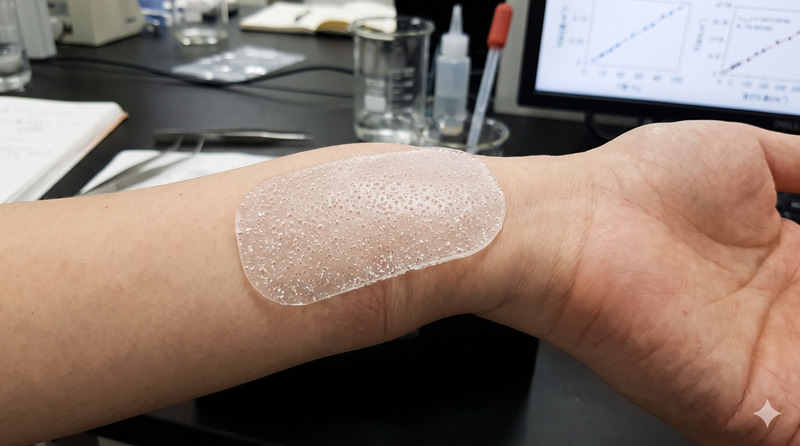
Patches and wearable devices attached to the skin need to move with it while reducing the buildup of heat and moisture. But creating air pores in a material can increase the amount of insulating air and reduce its thermal conductivity. The research team focused on creating pores inside the material while preserving pathways for heat to travel.
■ Tiny pores formed in a single curing step
The team mixed particles of hexagonal boron nitride (hBN), which conducts heat well, with a flexible silicone-based polymer (PDMS), then added perfluorohexane (PFH), which evaporates easily. As the mixture cured, the PFH turned into gas and escaped, leaving tiny pores in the material. The pores are formed in a single curing step, without separate washing or solvent extraction.
By adjusting the amount of additive, the proportion of the material’s total volume occupied by pores ranged from about 15% to 31%. The pores had an average diameter of about 19.63–24.68 μm, depending on the manufacturing conditions. One micrometer is one-thousandth of a millimeter. The hBN particles formed connected paths along the pore walls, creating routes for heat to travel.
As a result, the porous composite membrane had a thermal conductivity of 0.22 W/m·K. This is about 38% higher than the 0.16 W/m·K thermal conductivity of pure PDMS, and similar to that of a nonporous hBN/PDMS composite. Introducing air pores can easily reduce heat transfer, but this material retained pathways for heat to travel, limiting the loss in performance.
■ Assessing skin moisture, heat transfer and deformation
The team examined heat transfer between the skin and the composite membrane using an infrared thermal imaging camera and computer simulations. When the membrane was attached to the inner arm of one healthy volunteer, the surface temperature of the covered area was 1.20 degrees lower than that of the surrounding bare skin 10 seconds after application. After 10 minutes, the temperature difference had fallen to 0.40 degrees. Immediately after the membrane was removed, the skin at the application site was still measured at 0.45 degrees cooler than the surrounding area. Computer simulations also showed results similar to the reduction in heat buildup observed in the experiment.
Differences were also seen in the skin moisture indicator. At the site where a nonporous hBN/PDMS composite membrane was applied, the indicator rose to 146.2% of its initial value after five minutes and reached 159.5% after 30 minutes. By contrast, with the porous membrane, it remained between 103.1% and 107.1% of the initial value over 60 minutes. The team concluded that the tiny pores provided pathways for water vapor to move, reducing moisture buildup between the skin and the membrane. These figures compare skin moisture levels with a baseline; they are not direct measurements of sweat output.
The team also tested whether the material deformed in a way similar to skin. In a test using negative pressure, the porous composite membrane deformed by 0.346 mm, close to the 0.496 mm measured for bare skin. The deformation of nonporous pure PDMS was 0.066 mm. The membrane’s recovery, or the extent to which it returned to its original state after deformation, measured 0.326 mm. However, the skin application test involved only one healthy volunteer, so further research is needed to determine whether the same results hold with long-term wear or across a range of skin conditions.
The findings were published online on the 12th in the international journal Advanced Composites and Hybrid Materials. Amorepacific plans to use the material in digital sensory research to objectively evaluate the feel of cosmetics. The idea is to apply cosmetics to the composite membrane, measure heat and moisture transfer, and then assess how those results relate to the feel consumers experience.
[email protected] Kim Man-gi Reporter