Former Justice Minister Park Sung-jae's sentence sharply reduced on appeal ... 25 years to 9 years
- Input
- 2026-10-21 16:31:03
- Updated
- 2026-10-21 16:31:03
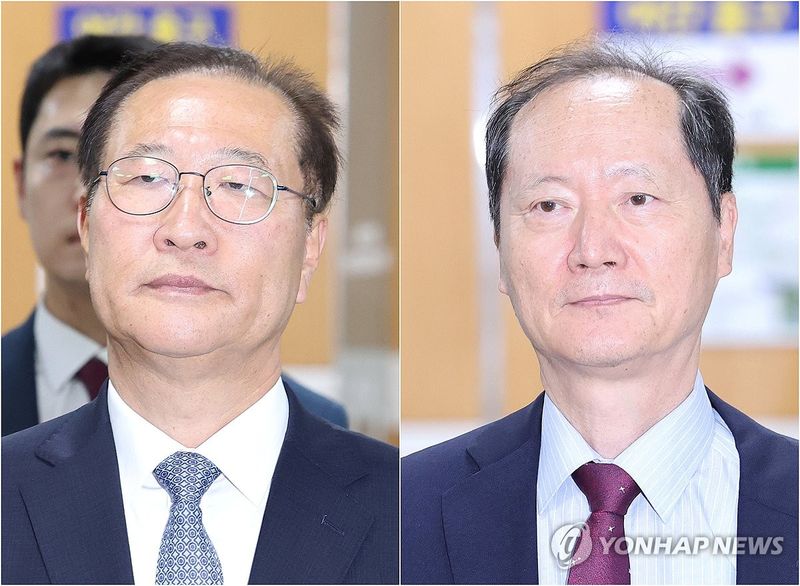
[Financial News] Former Justice Minister Park Sung-jae, who was sentenced to a heavy 25-year prison term in the first trial for allegedly taking part in the December 3 Martial Law, had his sentence sharply reduced to nine years on appeal. The appellate court found him guilty of some charges of participating in the insurrection, but overturned the first-instance ruling on allegations including that he ordered prosecutors and other personnel to be sent to the Martial Law Joint Investigation Headquarters, acquitting him of those charges.
On the 21st, Criminal Division 1 of the Seoul High Court, presided over by Judge Yoon Sung-sik, sentenced former Minister Park to nine years in prison on charges including performing an important role in an insurrection. That was 16 years less than the 25-year sentence imposed in the first trial.
As in the first trial, the appellate court found Park guilty of performing an important role in the insurrection for his involvement in enforcing the martial law proclamation despite knowing that the December 3 Martial Law was unconstitutional and illegal. Specifically, it upheld as guilty his instructions for personnel responsible for exit-ban duties to report to work and remain on standby, and to review the capacity of correctional facilities in the Seoul metropolitan area.
However, it found him not guilty of all the remaining charges of performing an important role in the insurrection and of abuse of authority causing obstruction of the exercise of rights.
The court overturned the first-instance ruling on the allegations that Park ordered a review of the status of detention cells actually available for use at Seoul Detention Center and instructed that prosecutors and other personnel be sent to the Joint Investigation Headquarters. It also found him not guilty of all charges of abuse of authority involving the head of the Ministry of Justice’s Immigration and Foreign Policy Headquarters, the head of its Corrections Bureau, and the director of its Prosecutors Division.
Regarding the review of inmate-cell availability at Seoul Detention Center, the court found that “it is difficult to conclude that former Minister Park instructed the head of the Corrections Bureau at the time to review the status of detention cells at Seoul Detention Center that were actually available for use.”
Regarding the dispatch of personnel to the Joint Investigation Headquarters, the court explained that “a general instruction merely to review the matter in preparation for a possible request for personnel does not make it possible to conclude that it contributed to achieving the aims of the insurrection.” It also acquitted him of abuse of authority, reasoning that it was difficult to conclude that he had made the officials concerned do something they were not legally required to do.
The court noted, however, that Park had not clearly stated his opposition to martial law and had instructed officials on what was needed to enforce the proclamation, saying that he “actively participated in this unconstitutional martial law.” In determining the sentence, it also considered that it was difficult to conclude that he had conspired in advance to impose martial law with former President Yoon Suk Yeol and others, and that no actual consequences such as detention or exit bans had resulted.
Meanwhile, the appellate court overturned the first-instance dismissal of the indictment against former Minister of Government Legislation Lee Wan-kyu, who was tried alongside Park. It found that the complaint concerning Lee’s alleged perjury before the National Assembly was also a complaint related to insurrection or foreign aggression and therefore fell within the scope of investigations under the special counsel law. The court remanded the case to a panel of the Seoul Central District Court.
[email protected] Choi Eun-sol Reporter