Lee: “Ask Gemini; the claim that the Serious Crime Investigation Agency chief cannot attend Cabinet meetings is absurd”
- Input
- 2026-10-21 16:30:54
- Updated
- 2026-10-21 16:30:54
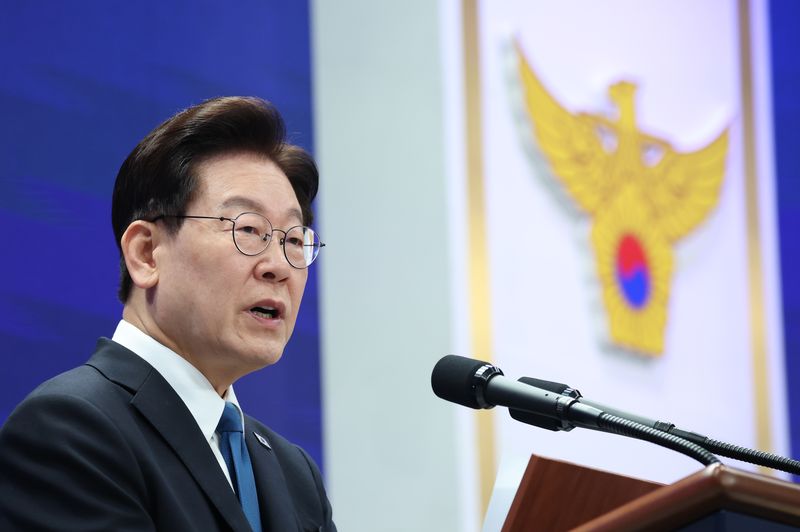
[Financial News] President Lee Jae-myung has directly rebutted the controversy over whether the heads of the Public Prosecution Office and the Serious Crime Investigation Agency may attend Cabinet meetings, releasing an artificial intelligence (AI) response that called the argument against their attendance “an unconstitutional absurdity.” He says there is no problem with their attending Cabinet meetings, since investigative and prosecutorial agencies are also administrative bodies subject to the president’s direction and supervision. Legal experts, however, have voiced concern that, regardless of whether attendance itself is lawful, it could substantially undermine the political neutrality and independence of investigative agencies.
On the 21st, President Lee shared an answer from Google AI Gemini along with a post on his X (formerly Twitter) account that read, “I asked Gemini.”
According to the post shared by President Lee, Gemini said, “The argument that the heads of the Public Prosecution Office and the Serious Crime Investigation Agency may not attend Cabinet meetings denies Article 11 of the Government Organization Act and is an unconstitutional absurdity.” It added, “The claim that the heads of the Public Prosecution Office and the Serious Crime Investigation Agency should be barred from Cabinet meetings is sophistry that directly denies the president’s administrative oversight authority and the government’s chain of command, as provided for in the Constitution and the Government Organization Act.”
Gemini explained, citing Article 66, Paragraph 4 of the Constitution and Article 11 of the Government Organization Act, that the president, as head of the government, has the authority to direct and supervise the heads of central administrative agencies.
Earlier, Serious Crime Investigation Agency chief Kim Ji-yong attended a Cabinet meeting chaired by President Lee for the first time on the 20th. Some raised concerns that this could undermine the independence and neutrality of investigations. It had been customary for heads of investigative agencies to stay away over concerns that their political neutrality could be compromised. However, after President Lee directed the heads of external agencies under each ministry to attend in December last year, the Prosecutor General of South Korea and the acting Commissioner General of the Korean National Police Agency have attended since January.
Legal scholars, on the other hand, have raised concerns that the attendance of investigative agency chiefs at Cabinet meetings could substantially infringe on the independence of investigative powers. Jang Yong-guk, a professor at Hongik University’s College of Law, said, “In our legal system, case law holds that substance takes precedence when form and substance differ.” He added, “The Serious Crime Investigation Agency is also, in effect, a quasi-judicial body. Although its work is called investigation, it is an institution that makes judgments—intermediate judgments, not final ones.” He continued, “The executive branch is fundamentally based on a hierarchy and a relationship of direction and command. If that is applied to investigative agencies as is, investigations into those higher up become impossible,” stressing, “None of them should attend—not the Serious Crime Investigation Agency, the National Police Agency or the Public Prosecution Office.”
Kim Dae-geun, head of the Legal Policy Research Office and a research fellow at the Korean Institute of Criminology and Justice, said, “Judicial independence has a constitutional basis, but investigative independence does not.” He nevertheless noted, “The independence of investigations is not about the independence of investigative agencies or those who conduct investigations; it is a measure to protect the freedom and equality of the people subject to investigation.”
Kim said, “Attendance at Cabinet meetings is lawful, but depending on the agenda and the matters reported, it could raise concerns about independence.” He added, “There is no problem with reports on budgets or staffing, since those are ordinary administrative matters, and it is also possible to discuss crime-response policies or improvements to the investigative system. But reporting on or giving directions concerning a particular person or case could raise legal problems.”
After sharing Gemini’s answer, President Lee posted again on X, emphasizing, “The heads of all agencies, including the Korea Forest Service, the National Fire Agency and the Korea Coast Guard, attend and take part in discussions. Correcting the mistaken perception and practice of giving investigative agencies special treatment is also a return to normalcy.” He added, “The heads of the Serious Crime Investigation Agency and the Public Prosecution Office are simply agency chiefs subject to the direction of the president, prime minister and ministers,” and said, “Just as I don’t give ministers specific instructions on permits and approvals, I won’t direct investigations into specific cases, so there’s no need to worry.”
President Lee also responded to a post arguing that having the heads of the Serious Crime Investigation Agency and the Public Prosecution Office attend Cabinet meetings would not make prosecutors obey or be loyal to him. “Prosecutors do not need to be loyal to the president, there is no need to make them so, and they must not be made so,” he said. “All public officials need only be loyal to the people and carry out their duties fairly and impartially.”
[email protected] Choi Jong-geun, Kim Dong-gyu Reporter