Stem cell injections show 'potential' as a treatment for end-stage knee arthritis... Overseas clinical findings draw attention
- Input
- 2026-10-21 16:16:24
- Updated
- 2026-10-21 16:16:24
[Financial News] Overseas clinical research findings have been reported showing that patients with end-stage knee osteoarthritis who had been advised to undergo joint replacement surgery experienced improvements in pain and joint function after receiving a single injection of stem cells extracted from their own blood.
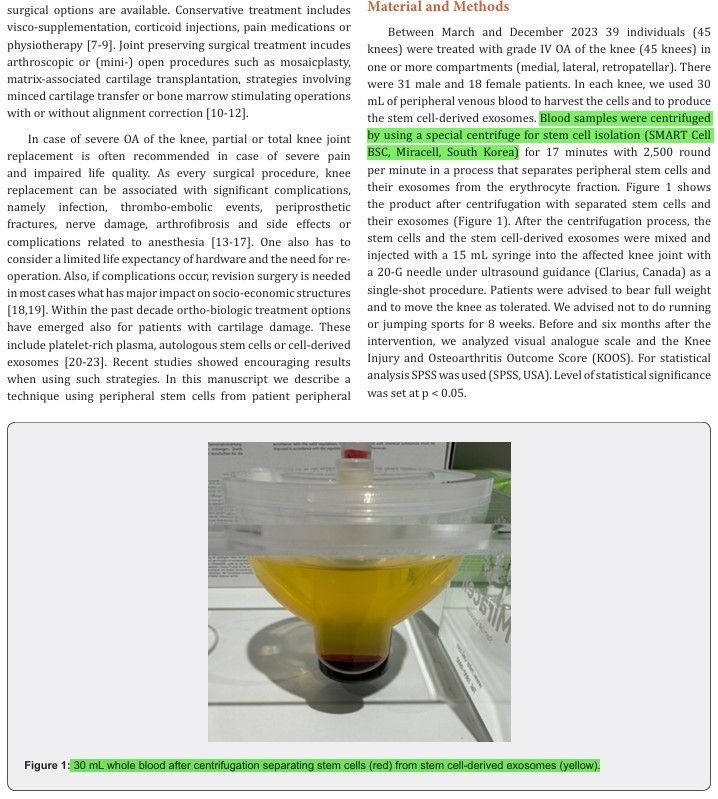
The study used SMART M-CELL, a cell extraction and concentration system developed by Miracell, a South Korean company specializing in stem cells. The method involves separating stem cells and cell-derived exosomes from a patient's blood and injecting them into the damaged knee joint.
A research team led by Austrian orthopedic surgeon Dr. Patrick Weninger published a related paper in the international journal Orthopedics and Rheumatology Open Access Journal in June 2024. The paper was titled “Symptomatic Improvement After a Single Combined Injection of Autologous Peripheral Blood Stem Cells and Stem Cell-Derived Exosomes in Patients With Severe Grade 4 Knee Osteoarthritis.”
The study included 39 patients with stage 4 knee osteoarthritis (45 knee joints) who received treatment between March and December 2023. All had been advised to undergo total knee replacement but wanted nonsurgical treatment.
The research team centrifuged the patients' venous blood using SMART M-CELL and then injected a concentrate containing stem cells and exosomes into the knee joint once, under ultrasound guidance.
An analysis six months after treatment found that symptoms had improved in all patients. Both the visual analog scale (VAS) and the Knee injury and Osteoarthritis Outcome Score (KOOS) improved significantly, with gains across all categories, including pain, symptoms, activities of daily living and quality of life. No patients' symptoms worsened during the follow-up period, and all patients said they were satisfied with the treatment outcome.
Changes were also observed on imaging. In 11 patients who underwent MRI, bone marrow edema associated with pain and joint damage had improved six weeks after treatment. No serious adverse events related to the injection procedure were reported.
The research team described it as “a study demonstrating the potential of a nonsurgical treatment strategy that could be considered before surgery for patients with severe knee osteoarthritis.”
However, the study followed a relatively small group of 39 patients for six months without a control group. Comparative studies tracking more patients over a longer period are needed to determine how long the effects last, whether the cartilage actually recovers, and whether the treatment can delay or replace joint replacement surgery.
A Miracell representative said, “This study has great clinical significance because it offers a practical nonsurgical alternative to joint replacement surgery for patients with stage 4 end-stage arthritis, often called the ‘final stage.’ Building on SMART M-CELL’s technology, proven in orthopedic settings overseas, we will expand innovative regenerative treatment options for patients with a range of musculoskeletal conditions who face a significant burden from surgery.”
[email protected] Jung Myung-jin, Medical Correspondent Reporter