“So minor violations can be let off lightly” ... Base surcharge rate for violations of the Credit Information Act cut to as low as 1%
- Input
- 2026-10-21 16:49:25
- Updated
- 2026-10-21 16:49:25
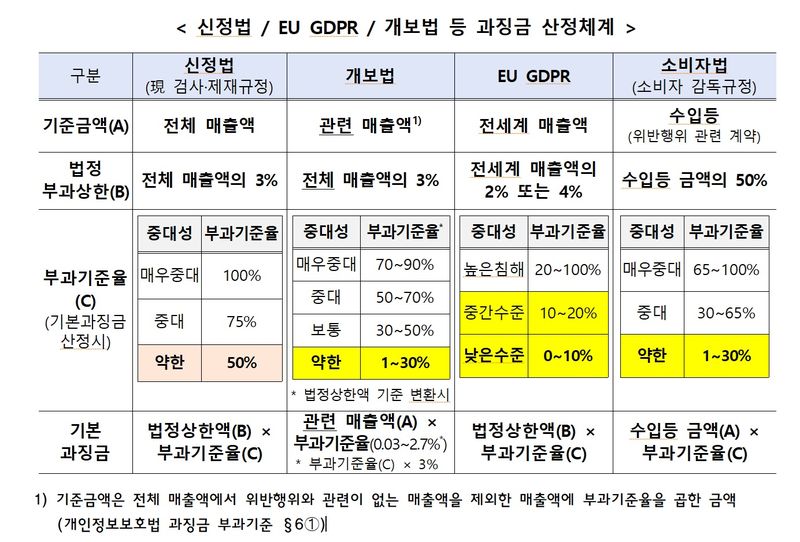
On the 21st, the FSC said it had held a regular meeting and revised the base rate for surcharges for violations of the Credit Information Act. The amendment will reduce the surcharge burden for minor violations while allowing increased penalties for repeated violations and large-scale credit information leaks. The amended regulations will take effect on the 23rd and apply to surcharges imposed from that date onward.
Under the Credit Information Act, the basic surcharge is calculated by multiplying the statutory maximum—3% of total sales—by a base rate determined by the severity of the violation. The final amount is then set after taking into account factors that increase or reduce the surcharge, as well as the company’s ability to pay. The rates are currently fixed at 50% for violations of low severity, 75% for serious violations, and 100% for very serious violations. Going forward, they will be broken down into ranges: at least 1% but less than 30%, at least 30% but less than 65%, and at least 65% but no more than 100%, respectively.
As a result, surcharges may vary according to the severity of a violation, even when violations fall into the same category. For example, if a financial company with annual sales of 7 trillion won commits a minor violation and is subject to a base rate of 10%, its basic surcharge would fall by 80%, from 105 billion won to 21 billion won. These figures are before any increases or reductions.
By contrast, if a company repeats the same violation or causes significant social harm, such as through a large-scale credit information leak, the basic surcharge may be increased by up to 100%, subject to the statutory maximum. The grounds for reducing surcharges have also been broadened to encourage companies to strengthen information protection voluntarily and respond promptly to harm.
When assessing the severity of a violation, the criteria will take into account the “type and nature of personal credit information” instead of the “amount of unjust enrichment,” and the “scale of damage” has been specified as the “scale and impact of harm to data subjects.” As a rule, violations that occurred before the new regulations take effect will be subject to the rules in force at the time, but the amended regulations may be applied if the new standards are more favorable to the violator.
[email protected] Park Mun-su Reporter