Hyundai Mobis accelerates localization of automotive semiconductors; first application in new Hyundai Motor Company vehicles planned for 2029
- Input
- 2026-10-21 16:00:08
- Updated
- 2026-10-21 16:00:08
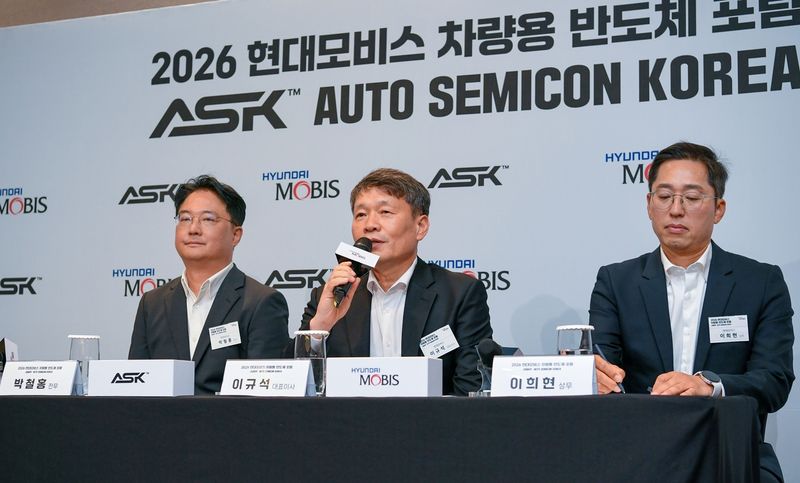
[Financial News] Hyundai Mobis has selected target vehicle models for nine of the 13 types of automotive semiconductors it is co-developing with domestic semiconductor companies, and plans to use them in new Hyundai Motor Company vehicles slated for release in 2029.
A vehicle semiconductor One Team task force (TF), led by Hyundai Mobis and others, has been launched, broadening the scope of collaboration—which had focused on semiconductor design and manufacturing—to include software, testing and evaluation. A strategy has also been drawn up to make localization results tangible by coordinating the process from planning the semiconductors vehicles need through development, verification and mass production.
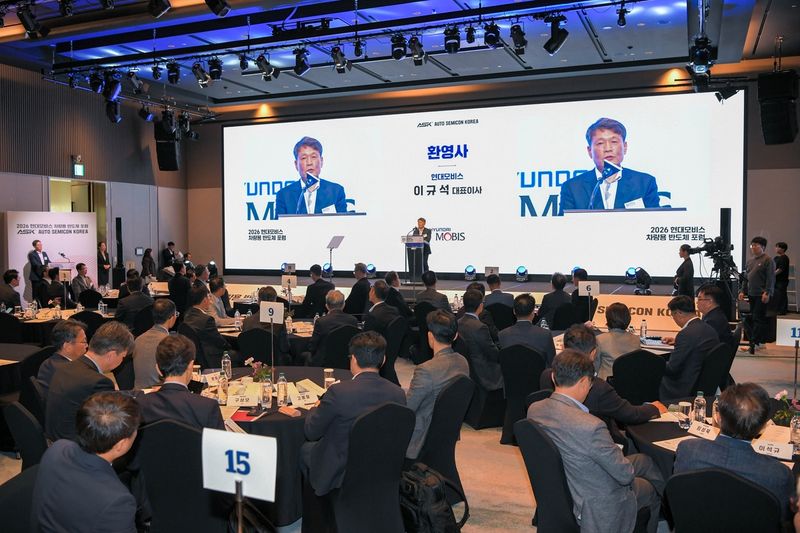
Hyundai Mobis held the second Automotive Semiconductor Forum, Auto Semicon Korea (ASK), at the DoubleTree by Hilton Seoul Pangyo hotel in Seongnam, Gyeonggi Province, on the 21st.
ASK was launched last year to connect the capabilities of automakers, parts suppliers, fabless companies specializing in semiconductor design, and foundries that manufacture chips under contract. The number of participating companies and institutions rose from 27 last year to 53 this year. In addition to existing participants such as Samsung Electronics, SK keyfoundry and LX Semicon, the scope of collaboration has expanded to include intellectual property (IP), testing and evaluation, and functional safety.
Over the past year, 19 collaborative system semiconductor projects have been identified. Development has begun on 13 types, and target vehicle models have been selected for nine. The effort has moved beyond exploring the potential to adapt domestic companies’ semiconductor technologies for home appliances, mobile devices and industrial use to a development phase aimed at actual installation in vehicles.
At an earlier press briefing, Hyundai Mobis President Lee Kyu-suk said, “Automotive semiconductors that have been developed and localized could enter mass production as early as around 2029.” He added, “This means that, starting next year, vehicles equipped with the automotive semiconductors under development will be deployed from the initial stages of testing. Once they are validated in the first vehicle model, their use will be expanded to subsequent models.”
Lee explained, “Unlike semiconductors for mobile devices or communications, automotive semiconductors have a long service life once developed. As the share of automotive semiconductors in the semiconductor market grows, we can create a collaborative model that will also benefit Hyundai Motor Group in the future.”
On power semiconductors, which are also used in electric vehicles, Lee added, “There is not yet an R&D fab for this in Korea. We will sign an MOU, discuss building a domestic R&D fab going forward, and produce samples of products designed by fabless companies.”
In connection with this, the launch ceremony for the Automotive Semiconductor One Team TF, led by the Ministry of Trade, Industry and Energy, was also held at the ASK forum that day. Hyundai Mobis, Hyundai Motor Company and LG Electronics are participating as demand-side companies, along with a total of 24 companies and institutions, including HL Mando, SK keyfoundry, DB HiTek and LX Semicon.
Through the TF, fabless companies will develop semiconductors to specifications provided by demand-side companies, securing stable customers, while foundries and packaging companies will expand their businesses into automotive semiconductors. Demand-side companies also aim to build a stable supply chain through the initiative.
Kim Jeong-kwan, Minister of Trade, Industry and Energy, who attended the event, said, “It is important to establish an ongoing cooperation framework that brings together the government and many businesspeople. Through the Automotive Semiconductor One Team TF, companies will be able to secure stable sources of demand and expand into automotive semiconductors, broadening the supply chain.” He added, “I will make sure that technologies such as automotive semiconductors are successfully developed through to commercialization.”
[email protected] Kim Hak-jae Reporter