Serious Crime Investigation Agency commissioner sits in on Cabinet meeting... ‘Even if lawful, it could substantially infringe on investigative independence’
- Input
- 2026-10-21 15:43:57
- Updated
- 2026-10-21 15:43:57
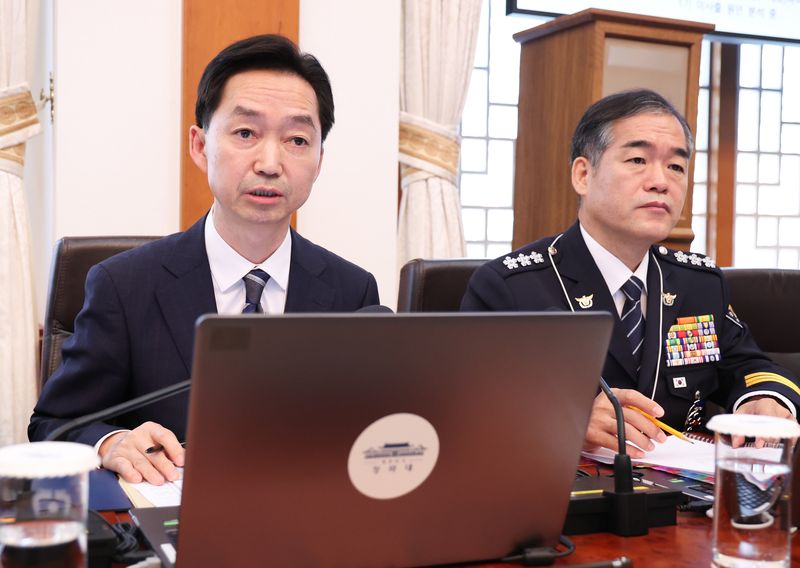
Commissioner Kim first attended a Cabinet meeting chaired by President Lee Jae-myung on the 20th. It had been customary for the heads of investigative agencies not to attend, out of concern that their political neutrality could be compromised. However, after President Lee directed the heads of external agencies under each ministry to attend last December, the Prosecutor General and the acting Commissioner General of the Korean National Police Agency have been attending since this January. On the 21st, President Lee posted on social media (SNS), ‘The claim that sitting in is impermissible is unconstitutional sophistry.’ Article 11 of the Government Organization Act, which he cited as the basis, stipulates that the president, as head of government, may direct and supervise the heads of all central administrative agencies.
Some in legal circles have countered that the nature of Cabinet meetings must be considered first. Jang Yong-guk, a professor at Hongik University’s College of Law who studies constitutional law and law and economics, explained, ‘The Cabinet meets in the president’s capacity as head of the executive branch, not as head of state.’ He added, ‘That is why members of the legislature do not attend unless they also serve as ministers, and the chief justice of the Supreme Court does not attend either.’
Professor Jang argues that although the Serious Crime Investigation Agency is formally an external agency of the executive branch, legal judgments should be based on substance. ‘In our legal system, when form and substance differ, the position reflected in case law is that substance takes precedence,’ he said. ‘The Agency is also, in effect, a quasi-judicial body. It may be called an investigative agency, but it makes determinations—and intermediate ones, rather than final determinations.’ He continued, ‘The executive branch is fundamentally based on hierarchy and relations of command and direction. If those were applied as is to investigative agencies, investigating higher-ups would become impossible.’ He stressed, ‘The National Police Agency and the Public Prosecution Office, as well as the Serious Crime Investigation Agency, should not participate.’
Another view was that the nature of investigative independence itself should be reconsidered. Kim Dae-geun, head of the Legal Policy Research Division and research fellow at the Korea Institute of Criminology and Justice, who studies legal philosophy and political thought, noted, ‘Judicial independence has a constitutional basis, but investigative independence does not.’ He added, ‘The independence of investigations is not about the independence of investigative agencies or those who conduct investigations; it is a measure to protect the freedom and equality of the people subject to investigation.’
Kim said the legality of sitting in on meetings must be distinguished from the possibility of substantive infringement. ‘Attendance at Cabinet meetings is lawful, but depending on the agenda and the matters reported, there may be concerns about independence,’ he said. ‘Reports on budgets or staffing are ordinary administrative matters and pose no problem. Discussions on crime-response policy or improvements to the investigative system are also possible. But reports or instructions concerning a specific person or case could pose a legal problem.’ As grounds, he cited the fact that ‘the Public Prosecution Office Act also provides that only the minister may issue specific directions.’
The People’s Solidarity for Participatory Democracy also opposed the arrangement in a commentary on the 15th, saying, ‘A structure in which the heads of investigative and prosecutorial agencies regularly attend meetings chaired by the president and share the direction of state affairs places them under political pressure even without instructions on specific cases.’ The Serious Crime Investigation Agency says no decision has been made on whether Commissioner Kim will attend future meetings, but that there is no legal basis for refusing to attend.
[email protected] Kim Dong-gyu Reporter