LH to commission 16,000 modular homes by 2030
- Input
- 2026-10-21 15:38:40
- Updated
- 2026-10-21 15:38:40
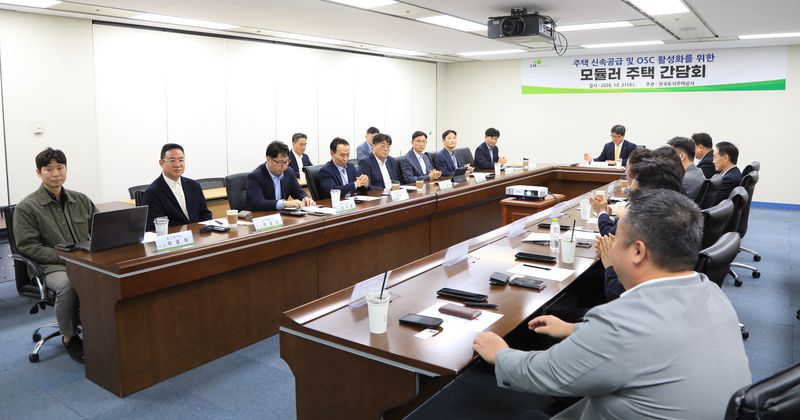
[Financial News] Modular homes made from factory-produced modules and assembled on site will be brought to market through orders from Korea Land and Housing Corporation (LH), with 16,000 units to be commissioned by 2030. This year's volume is 2,100 units, exceeding the initial target of 2,000. LH is also developing an “AI Modular Home” model incorporating artificial intelligence (AI) appliances in partnership with Samsung Electronics and LG Electronics.
According to LH on the 21st, it will commission 3,000 units annually from 2027 to 2029 and 5,000 units in 2030, for a total of 14,000 units over four years. The government set a target of supplying 20,000 public modular homes by 2030 in measures including the “8.13 Housing Rapid Supply Plan.” LH will be responsible for 70% of that total. Its plan is to achieve economies of scale that lower production costs by maintaining a steady flow of orders each year.
The remaining orders through the end of the year are concentrated in the Third New Towns and northern Gyeonggi Province. This month, LH will invite bids for Goyang Changneung Block A3 (668 units) and Namyangju Wangsuk 2 Block A10 (555 units) as public housing projects with private-sector participation using modular construction. Pocheon Songu 2 Block A1 (916 units) will follow in December. The entire complex, not just some of its buildings, will be built using modular construction.
There is a reason the industry is watching the steady stream of orders. Modular construction can cut construction time by 20–30% compared with reinforced-concrete construction, but costs about 30% more because the market is still at an early stage. The business model requires a steady volume of orders to justify investment in factory equipment. In its 8.13 measures, the government also raised its target for public modular housing orders from 12,000 to 20,000 units for 2027–2030. It decided to subsidize about half of the additional construction costs compared with conventional methods. On construction sites, buildings are increasingly going higher. The 22-story Uiwang Chopyeong Block A4 (381 units), being built by LH in Gyeonggi Province, is the tallest modular housing project in Korea. Steel-frame modular buildings of up to 14 stories will also be built at Siheung Geomo Block A-1. Last year, a special bill to support the promotion of modular construction was introduced in the National Assembly.
The feature that drew the most interest was the “AI Modular Home.” Because modular homes are manufactured in factories, AI appliances and an energy management platform can be integrated into the home from the design stage. Residents can benefit from home-management services and energy savings, while also enjoying improved housing performance. LH plans to develop this into a next-generation smart housing model.
In its mid- to long-term roadmap, LH set a goal of cutting construction time in half by 2030 and bringing construction costs down to the level of conventional reinforced-concrete (RC) construction. To that end, it is working to realize 22-story modular buildings and establish a foundation for mass, automated production using standardized designs and floor plans. Based on LH's standard modular floor plan released last December, it also created a new item category and registered products with the Public Procurement Service in March this year. It is also pursuing institutional improvements, including changes concerning owner-supplied materials and exceptions to the separate contracting requirements for electrical and information and communications work.
Park Hyeon-geun, head of LH's Public Housing Division, said, “Modular housing can achieve both dramatic reductions in construction time and high-quality construction, making it a key alternative for rapidly supplying housing. We will carry out our order roadmap through 2030 without a hitch, while evolving modular housing into smart AI living spaces and taking the lead in the homes of the future.”
[email protected] Jeong Gyeong-su Reporter