France imposes curfews and even deploys troops... Financial crisis amid extreme protests
- Input
- 2026-10-21 16:00:54
- Updated
- 2026-10-21 16:00:54
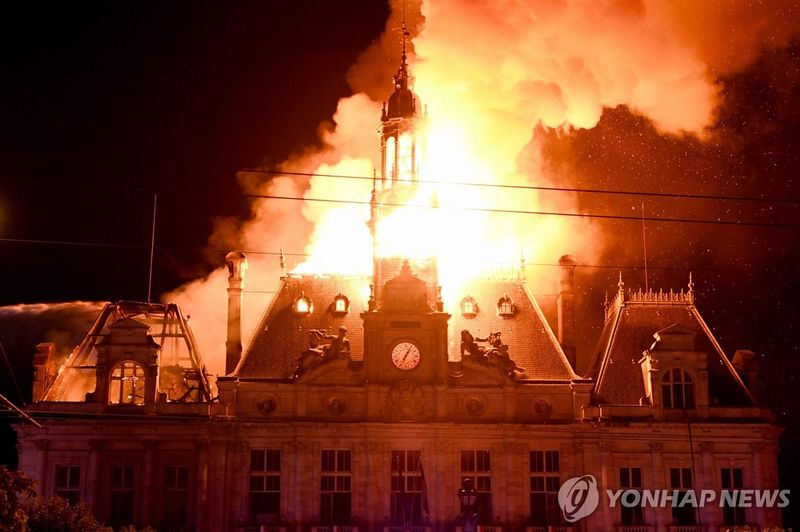
[The Financial News] French government bond yields are surging again amid radical protests and violence. Urgent fiscal consolidation is needed, but pressure from protesters demanding support for livelihoods and a divided political class unable even to pass a fiscal consolidation budget are fueling the fiscal crisis.
France’s 10-year government bond yield rose to 4.96% intraday on the 20th (local time), widening the gap between French and German 10-year yields to 1.54 percentage points. Earlier this month, as fiscal anxiety mounted sharply, the yield climbed to 4.9937%, its highest level since July 2002, while the spread over German government bonds widened to 1.59 percentage points. The current figures are close to those levels. They also exceed levels seen in the early 2010s, when the Eurozone debt crisis was at its peak.
■Government bond yields hit their highest level since 2002 With the presidential election six months away next April and parliament divided, markets are skeptical that the minority government can pass its budget. This lack of confidence is shaking financial markets, affecting stocks, government bonds and the currency at the same time. Next year’s budget includes €43 billion in new fiscal consolidation measures to reduce the deficit.
France’s national debt stands at 119% of gross domestic product (GDP), its highest level since 1946. The fiscal deficit is also forecast to reach 5.4% of GDP. Even so, protesters have stepped up calls for increased spending to support people’s livelihoods and improve public services.
The Paris stock market fell for a second consecutive day. According to Investing.com, the CAC 40 index closed down 0.38% on the 20th from the previous day. It had also fallen 1.1% the day before, as concerns about the protests and fiscal instability intensified.
Moody’s, the credit rating agency, is set to announce its assessment of France’s sovereign credit rating on the 23rd, with another shock expected. Moody’s has assigned France an Aa3 rating with a “negative” outlook.
Deutsche Bank analyst Jim Reid said, “Amid difficult fiscal conditions in France, the 2027 presidential election has added another political risk for markets.” Mike Bell of asset manager RBC BlueBay told CNBC that “France faces a real risk of falling into its own sovereign debt crisis” and said it “needs to normalize its public finances.”
■Troops to be deployed for protests on the 24th
Last weekend, mass protests involving more than 550,000 people and calling for increased investment in the public sector escalated into violent arson, prompting curfews. Market jitters have intensified and are likely to fuel this trend further.
In this situation, the Macron government is caught between protesters’ demands for support for livelihoods and improved public services, and financial markets’ calls to reduce national debt and the fiscal deficit. It must respond to anger over the rising cost of living even as investors demand fiscal cuts.
The violent protests show no signs of subsiding, and a renewed sense of imminent crisis is in the air, likely to further fuel fiscal uncertainty.
Prime Minister Sébastien Lecornu said on X (formerly Twitter) on the 20th, “The curfew last night helped calm the situation,” adding, “There will be new curfew measures tonight wherever needed.” Curfews are reportedly planned for several more days in Bordeaux in the southwest and Nice in the south, as well as in the capital, Paris, and Lille in the north.
As arson and looting spread across the country, authorities also decided to deploy large numbers of police and security personnel, including military forces such as counterterrorism units, for the protests scheduled for the 24th. Prime Minister Lecornu repeatedly claimed that the violence was organized and that far-left forces were behind it. Interior Minister Laurent Nuñez also said, “We will deploy forces from Operation Sentinelle (the military's counterterrorism vigilance operation),” adding, “This is to allow the police and gendarmerie to focus on maintaining order.”
As violent protests intensified the turmoil, far-right National Rally (RN) candidate Marine Le Pen gained ground and led in several opinion polls. According to a Cluster17 poll released on the 19th, Le Pen was projected to win at least 31% of the vote in the first round next April and advance to the runoff in first place.
[email protected] Lee Seok-woo, international affairs specialist Reporter