“Keep Your Hair Even During Chemotherapy”... ‘Scalp Cooling,’ Already Standard Abroad [Lee Seon-min’s Hair Reboot]
- Input
- 2026-10-22 10:00:00
- Updated
- 2026-10-22 10:00:00
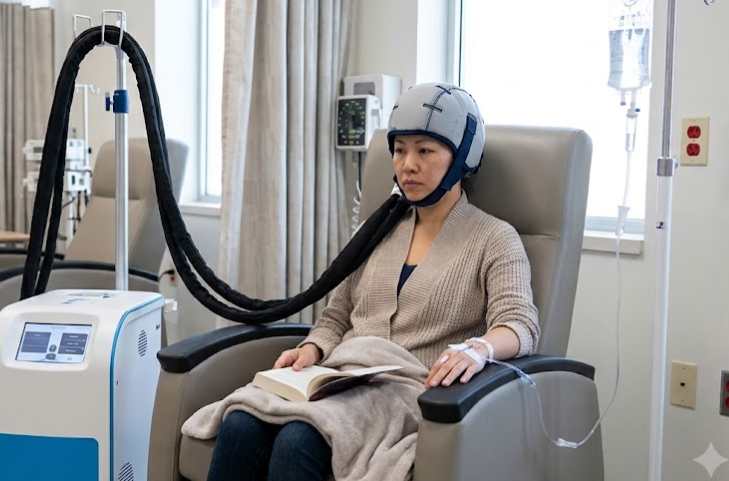
[Financial News] Some patients wear a cold cap during chemotherapy infusions. They do so for “scalp cooling.” The treatment has evolved from the use of ice packs or frozen caps to medical devices that circulate coolant and keep the scalp at a constant temperature. It has already become a standard option for preventing chemotherapy-induced hair loss at cancer centers abroad, but it is still unfamiliar to patients in South Korea.
Scalp cooling constricts blood vessels and puts hair follicles into “slow mode”
Chemotherapy works by targeting cells in the body that divide “rapidly.” Cancer cells, hair follicle cells and bone marrow are among its targets. As a result, chemotherapy kills cancer cells but also causes hair loss. Is there a way to prevent it? Abroad, scalp cooling is increasingly being used to prevent chemotherapy-induced hair loss.
Lowering the scalp skin temperature to around 20 degrees produces two changes. The blood vessels in the scalp constrict, reducing the amount of chemotherapy drug that reaches the hair follicles, while the metabolism and division of hair follicle cells slow down, making them less affected by the drugs. Scalp cooling therefore begins about 30 minutes before chemotherapy is administered and continues for at least 1–2 hours afterward.
In 2017, the Journal of the American Medical Association (JAMA) published two clinical trial results side by side, both involving patients with early-stage breast cancer. In a randomized study, about half of the patients who received scalp cooling kept their hair loss to 50% or less, while no patients in the control group did. In another prospective study, about two-thirds of patients who received scalp cooling preserved their hair to the same extent.
The U.S. Food and Drug Administration (FDA) approved scalp-cooling devices in 2015 and 2017 as medical devices to prevent hair loss in certain cancer patients. The devices were also included in the U.S. National Comprehensive Cancer Network (NCCN) breast cancer guidelines as an option to consider.
It is not effective for every type of chemotherapy
The effectiveness of scalp cooling varies depending on the type of chemotherapy drug used. Results are good with taxane-based monotherapy, while hair follicle preservation rates are lower when anthracyclines are included.
The results also depend on how snugly the cap fits against the scalp and whether the prescribed cooling time is followed. If the hair is long and thick, the cold may not be distributed evenly, so it is important to wet and arrange the hair before putting on the device. Patients should also take into account possible headaches and discomfort from the cold, as well as the longer time required for each treatment session.
The question most often asked is, “Doesn’t this also protect cancer cells that have spread to the scalp?” Studies to date have found scalp metastases to be very rare among patients with solid tumors who received scalp cooling, with no significant difference between patients who received the treatment and those who did not. However, the treatment has not been studied in blood cancers such as leukemia and lymphoma, where cancer cells can circulate in the blood, or in conditions sensitive to cooling, such as cold agglutinin disease.
Scalp cooling should be decided on before chemotherapy
Scalp cooling is available at some university hospitals and cancer centers in South Korea, but equipment availability and how the treatment is administered vary by institution. Chemotherapy schedules move quickly once set, so anyone interested should look into the treatment soon after diagnosis.
Scalp cooling is also most useful when started with the first round of chemotherapy, if possible. It is difficult to expect the full treatment effect once hair loss has already begun. Once a chemotherapy schedule is set, patients are advised to first consult their doctor about the drugs, cancer type and whether the treatment is an option.
If you are undergoing scalp cooling, you should also take steps to reduce physical stress on your hair, such as avoiding vigorous brushing and hot blow-drying. Scalp cooling is a treatment that “reduces” hair loss rather than “prevents” it. Understanding that difference when deciding whether to use it can lead to greater satisfaction.

[email protected] Kim Hyeon-seon Reporter