Yegaram Savings Bank, Hit by Data Breach Affecting 43,000, to Join the Financial Security Institute and Overhaul Security
- Input
- 2026-10-21 16:22:40
- Updated
- 2026-10-21 16:22:40
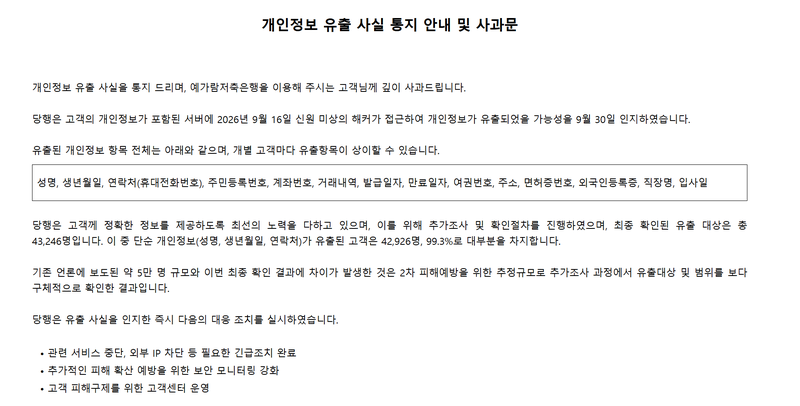
According to sources in the financial sector on the 21st, Yegaram Savings Bank is preparing to join the Financial Security Institute in the wake of a recent hacking incident.
Last month, the personal information of 43,246 Yegaram Savings Bank customers was leaked. The scale of the breach was the largest in this wave of hacking incidents in the financial sector. The personal information of 42,926 people, including their names, dates of birth and contact details, was leaked, while additional sensitive information, including resident registration numbers and account numbers, was reportedly exposed for the remaining 320 people.
Yegaram Savings Bank had not previously been a member of the Financial Security Institute. Membership is not a legal requirement. However, the bank decided to join, judging that the need to use a joint response system for the financial sector, alongside each company’s individual response, had grown as hacking attacks targeting financial institutions continued.
The Financial Security Institute is a specialized organization that supports joint responses to cyberthreats in the financial sector. Its members can receive shared information on cyberthreats such as hacking, as well as support for incident-response drills and security vulnerability assessments.
The bank will also change how it operates security monitoring. It plans to build a system that will enable it to conduct in-house the security monitoring it has outsourced to external firms. The aim is to strengthen surveillance by running external monitoring alongside its own. Yegaram Savings Bank has faced criticism that its detection of security threats and initial response were inadequate, after it took 14 days to detect a hacker’s abnormal access.
The scope of security testing will also be expanded. Until now, Yegaram Savings Bank has tested its systems mainly by checking for security vulnerabilities. Going forward, it plans to conduct AI-based simulated hacking based on assumed real-world attack scenarios, in response to increasingly sophisticated hacking methods.
A Yegaram Savings Bank official said, “We have not conducted AI-based simulated hacking tests so far, but we plan to have our systems assessed by an external specialist firm going forward.” The official added, “We have not yet drawn up the security budget, but we plan to increase it and hire more staff.”
The move comes as a series of hacking incidents in the financial sector have put the security response capabilities of small and midsize financial firms under scrutiny. For these firms, which have relatively limited security infrastructure and specialist staff, a key challenge is developing the capacity to assess threats internally and lead the response, even when they receive help from external specialists.
A financial-sector official said, “Small and midsize financial firms have relatively limited security staff and budgets, and the cost of joining the Financial Security Institute and using its services is also a burden.” The official added, “We need to encourage participation in the joint response system while also providing support to help these firms secure specialists who can assess threats internally and lead the response.”
[email protected] Lee Hyun-jung Reporter