‘Forced Repatriation of North Korean Fishermen’ Case: Suspended Prison Terms on Appeal... “Political Retaliation That Ignores the Special Circumstances Between the Two Koreas”
- Input
- 2026-10-21 15:13:22
- Updated
- 2026-10-21 15:13:22
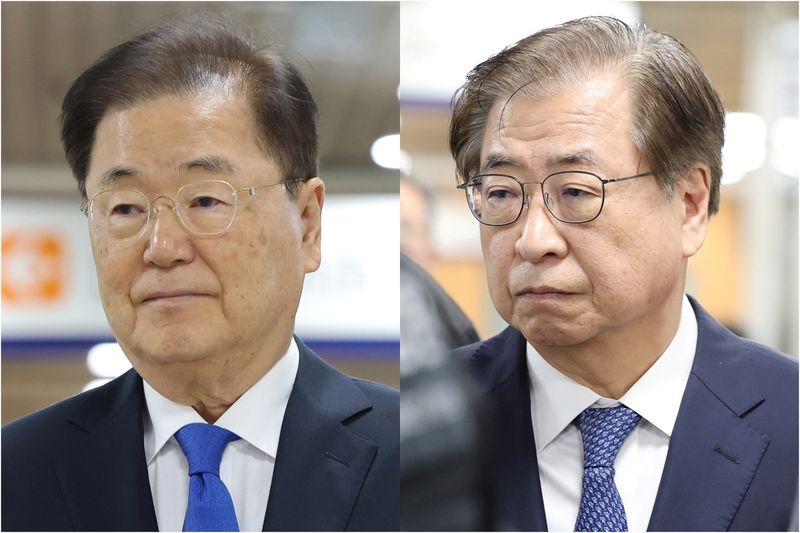
[Financial News] Foreign and security officials under the Moon Jae-in administration who sent North Korean fishermen back to North Korea despite their stated intention to defect were given suspended prison sentences on appeal. Their sentences were harsher than those at the first trial, which acknowledged the illegality but deferred sentencing.
On the 21st, the Seoul High Court’s Criminal Division 15-3, presided over by Judge Sung Eon-ju, sentenced Chung Eui-yong, former director of the National Security Office, and Suh Hoon, former director of the National Intelligence Service, to 18 months in prison each, suspended for three years. Kim Yeon-cheol, the former unification minister who was tried alongside them, was sentenced to one year in prison, suspended for two years. By contrast, Noh Young-min, the former presidential chief of staff, who had been accused of conspiring with them, was acquitted.
In November 2019, the Navy took two North Korean fishermen who had defected into custody while seizing a North Korean fishing boat that had crossed the NLL (Northern Limit Line). The two fishermen, accused of killing 16 fellow crew members, repeatedly expressed their intention to defect during questioning, but were repatriated through the repatriation procedure at Panmunjom on the 7th of the same month.
Later, in February 2023, under the Yoon Suk Yeol administration, the Office of Public Prosecution (then the prosecution) indicted four people involved in the decision to forcibly repatriate the fishermen—former director Chung, former director Suh, former chief of staff Noh, and former minister Kim—on charges including abuse of authority. They were accused of ordering officials in relevant ministries to forcibly repatriate the fishermen and preventing them from following procedures prescribed by law and exercising their right to a trial.
The first-trial court had acknowledged their unlawful actions but took into account the heinous nature of the crime and institutional gaps resulting from the division of the two Koreas. It deferred sentencing, setting prison terms of 10 months each for former director Chung and former director Suh, and six months each for former chief of staff Noh and former minister Kim.
The appeals court, by contrast, appears to have taken a stricter view of the charges of abuse of official authority. It overturned the deferred sentences handed down at the first trial and imposed prison terms suspended for a period of probation on former director Chung, former director Suh, and former minister Kim. However, it acquitted former chief of staff Noh, who had been accused of taking part in the decision-making process in his capacity as chief of staff, finding insufficient evidence of a crime.
In a joint statement, former director Chung, former director Suh, and former minister Kim said, “We cannot accept this unjust ruling, which failed to sufficiently consider the substance of the case and the special circumstances at the time,” and added, “We will immediately appeal to the Supreme Court of Korea to reveal the truth and prove the legal legitimacy of our actions.”
They went on to emphasize, “The two people who were repatriated were not innocent North Korean defectors who came to South Korea out of admiration for the country, but heinous criminals apprehended while fleeing after brutally killing 16 fellow crew members,” adding, “The government at the time decided to repatriate them after consulting the relevant ministries and comprehensively considering the lives and safety of the people, national security, and the special nature of inter-Korean relations.”
They also criticized the ruling, saying, “This was a matter in which the prosecution had already decided not to indict in November 2021, after more than two years of investigation, finding that the action was a legitimate execution of official duties and that the stated intention to defect was not genuine,” and, “If the power to punish is used as a means of political retaliation based on standards applied after the fact, while ignoring the special circumstances of the division of the two Koreas, what public official would in the future work with conviction for the country?”
Meanwhile, former President Moon Jae-in submitted a written plea to the court ahead of the appeals court ruling. Moon said, “Sending these heinous criminals back to North Korea without bringing them into the country was a decision made to protect the lives and safety of the people,” and, “It is unjust to subject that decision to judicial judgment after the fact.” He called for all the defendants to be acquitted but failed to prevent prison sentences from being imposed.
[email protected] Lee Chang-hoon Reporter