Bibimbap nears 12,000 won; instant rice prices climb too as soaring rice costs squeeze meal budgets
- Input
- 2026-10-22 16:37:52
- Updated
- 2026-10-22 16:37:52

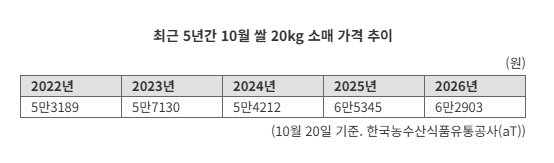
[Financial News] Rice prices have surged for the second consecutive year, driving up the cost of major restaurant meals and processed foods made with rice and adding to the burden on household food budgets.
According to the Korea Agro-Fisheries & Food Trade Corporation (aT) on the 22nd, the average retail price of rice (20 kg) was 62,903 won as of the 20th, 6,384 won (11.3%) above the average for a normal year (56,519 won). Although slightly lower than the price in October last year (65,345 won), a 20-kg sack continues to sell for more than 60,000 won.
The impact of rising rice prices is also sending restaurant meal prices higher. In August, the average price of a roll of kimbap in Seoul was 3,923 won, nearing 4,000 won. That was up 300 won (8.3%) from the same period a year earlier (3,623 won).
Over the same period, a set meal with kimchi stew rose from 8,577 won to 8,769 won, while bibimbap went from 11,577 won to 11,923 won, as prices for restaurant dishes made primarily with rice rose across the board.
Prices of processed foods are also rising, not just restaurant meals. The average selling price of instant rice increased by 52 won (3.3%), from 1,590 won in October last year to 1,642 won as of last month.
Domestic rice consumption is declining as changing eating habits coincide with the growing burden of higher prices. According to the Agricultural Outlook Center at the Korea Rural Economic Institute, domestic retailers sold 247,000 metric tons of rice through August, down 19,000 tons (7.1%) from the 266,000 tons sold in the same period a year earlier. The decline reflects broader changes in food culture, including the increase in one-person households and more Westernized diets.
Food companies are responding to these shifts in consumer demand by expanding their lines of small-portion instant rice. According to data from market research firm Nielsen, products weighing 130 g or less accounted for 16% of the entire instant rice market in the first half of this year, up from 4% in the first half of 2022—roughly a fourfold increase.
CJ CheilJedang introduced two 110-g varieties of Hetbahn Rice Plan Mini Rice in June (farro whole-grain rice and lentil brown rice), then launched Hetbahn Soft Mini Rice, a white-rice product, in September. In particular, Hetbahn Small Bowl Mixed-Grain Rice's share of total mixed-grain rice sales doubled in three years, rising from 13% in 2022 to 26% last year.
Ottogi also offers six small-portion instant rice products weighing less than 180 g. From the start of the year through September, sales of Ottogi's small-portion instant rice surged 83% from the same period a year earlier.
An industry source said, “We’re receiving more inquiries from buyers looking for smaller-size products. Demand for these products is surging due to high rice prices and reduced food consumption caused by Mounjaro, among other factors.”
[email protected] Park Kyung-ho Reporter