“Unconstitutional to Deny a Witness a Copy of a Warrant” vs. “Infringes on Investigative Secrecy” ... First-Ever Complaint Against a Court Ruling Sparks Clash
- Input
- 2026-10-21 17:55:34
- Updated
- 2026-10-21 17:55:34
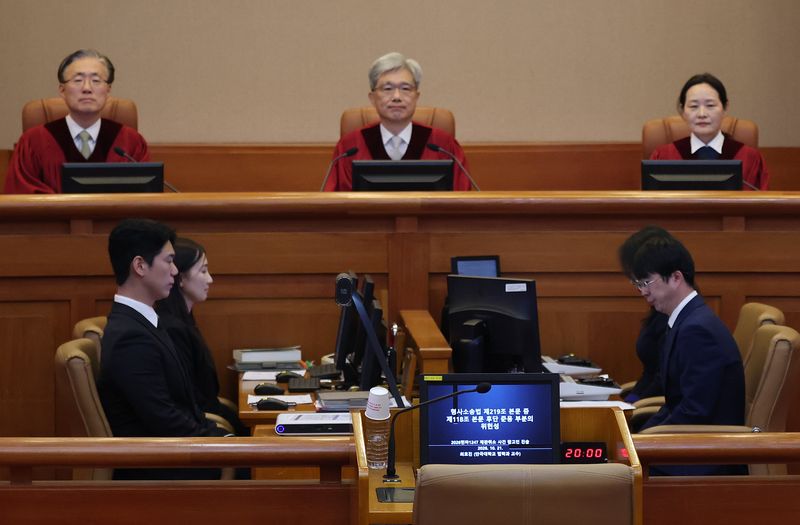
[Financial News] The first public hearing at the Constitutional Court of Korea in the “first-ever constitutional complaint against a court ruling” was held in a case seeking to overturn a court decision allowing investigative agencies not to provide a copy of a warrant to a “witness (third party)” who is not a suspect when executing a search and seizure. Justices fired a barrage of pointed questions as the right of the person subject to the search and seizure to mount an effective defense clashed head-on with the need to preserve investigative secrecy.
On the 21st, the Constitutional Court of Korea held the first public hearing in a case seeking to overturn a court ruling, filed by attorney Kim Young-soo over the Supreme Court’s dismissal of his re-appeal, in its Grand Courtroom. This is the first case to receive a full hearing in the Grand Courtroom since the amended Constitutional Court Act took effect, allowing constitutional complaints against court rulings.
The case began in July 2022, when the special counsel team investigating the case of the late Staff Sergeant Lee Ye-ram searched the home and office of attorney Kim, who was then a witness. Kim asked for a copy of the warrant to check the alleged facts and the scope of the search, but was denied. During a forensic examination of his mobile phone, investigators also seized a broad range of private information, including a family relations certificate and legal materials from other cases. Kim obtained cancellation of the unlawful seizure itself through a quasi-appeal, but filed a constitutional complaint after the Supreme Court ultimately dismissed his request to overturn the denial of a copy of the warrant.
At the hearing, attorney Kim argued, “Giving suspects copies of warrants while denying them to witnesses who are not even suspected of a crime directly violates the right to equality, the principle of due process, and the warrant requirement.” He pleaded, “They let you look at warrants running to dozens of pages for just a few minutes before taking them back immediately. With even note-taking or photography prohibited, how can you challenge an unlawful search?” He added, “The current practice, which amounts to no more than a formal presentation, completely guts the right to seek judicial redress, including through a quasi-appeal.”
Counsel for the Ministry of Justice countered that there was no violation of due process, saying, “The Constitution requires only that a warrant be ‘presented’; it does not require that a copy be provided.” The Ministry’s representatives argued, “Providing copies to witnesses creates a significant risk that investigative secrets will leak to suspects and lead to the destruction of evidence, and could result in the dissemination of suspects’ highly private information.” They added, “The Criminal Procedure Act’s provision requiring copies to be given only to suspects reflects a reasonable legislative choice.”
The justices pressed the Ministry of Justice on the petitioner’s argument that investigative practice fails to ensure “sufficient presentation” of warrants and that seizures of electronic information have surged.
The bench noted, “The number of search-and-seizure warrants, which stood at around 200,000 in 2017, has recently exceeded 530,000 a year, making seizures of electronic information routine.” It added, “It may be close to impossible for ordinary members of the public to understand the alleged crime and its scope and mount a defense simply by being shown a voluminous warrant briefly.”
In particular, the justices asked, “Countries such as Germany and the United States provide third parties with original warrants or copies, while deferring notification in exceptional cases. Isn’t completely excluding third parties, who suffer significant disadvantages in the name of investigative secrecy, treating them excessively as mere objects of the judicial process?”
The bench also pressed the petitioner on whether the failure to provide a copy had caused actual harm. It noted, “It is unclear what rights were actually infringed and what concrete disadvantage resulted simply from not receiving a copy at the scene.” It added, “Suspects and witnesses have different legal statuses and are subject to different procedures; it is questionable whether someone whose property was searched can demand exactly the same rights as a suspect solely on the grounds that they were subject to a search.”
[email protected] Lee Chang-hoon Reporter